After years of working across commercial hydroponics, institutional projects, and international pilots, Christer Tilk has grown cautious of systems that promise scale before they prove usability. As CEO and co-founder of Growpipes, he has seen capital-heavy automation and proprietary design move faster than the people expected to operate them.
"Many systems are designed for professional growers or engineers," Tilk says. "But most people who are interested in growing food are not experts." For him, that gap between system design and real users has become impossible to ignore. "If a system only works when everything is optimized, then it's not designed for people."
That thinking sits at the core of Growpipes' collaboration with HSB Living Lab, where shared hydroponic systems have been tested not in a controlled facility, but inside residential buildings where people actually live.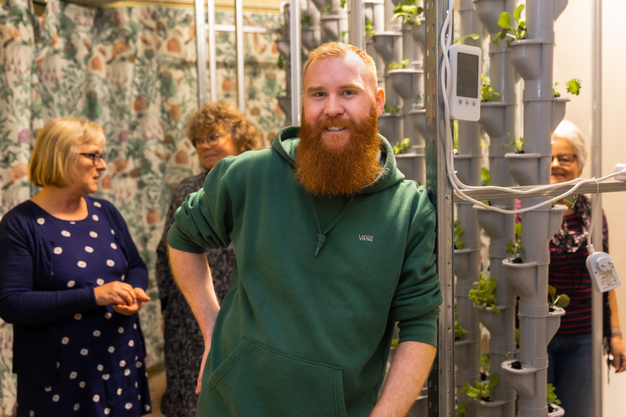 © Growpipes | HSB
From technology showcase to lived experiment
HSB Living Lab, based in Gothenburg, functions as both a residential building and a research environment. Operated by Sweden's largest housing cooperative federation, the Living Lab allows companies and researchers to test new technologies under everyday living conditions. Residents live in the building while systems related to energy, mobility, and sustainability are evaluated over time.
The Living Lab works closely with Chalmers University of Technology, using the building as a platform for applied research. Hydroponics entered the picture not primarily as a productivity experiment, but as a way to explore how shared cultivation might strengthen community life while making food production accessible to non-experts. Tilk says the framing was deliberate. "This wasn't about yield or efficiency. It was about asking whether people would actually want to do this together, and whether the system would support that without stress."
Designing for shared ownership
Unlike commercial indoor farms, the systems installed at HSB were deliberately simple by design. "We wanted a system that tolerates mistakes. If something goes wrong, it shouldn't become a crisis." The systems use circulating water, nutrients, and LED lighting, but avoid complex automation or tight optimization.
"Most of the people involved had no background in growing, so the system had to work even when nothing was optimized." Once residents took responsibility for daily operation, that design choice proved decisive. In the first pilots, participants were often older residents, many in their sixties or older, who volunteered to form cultivation groups. Over time, younger residents joined, often stepping in to help with technical tasks.
"What surprised me most was the dedication," Tilk says. "There was always one person who took the lead and then distributed responsibility across the group." Tasks were shared informally. Some residents handled weekly checks, others focused on harvesting or cleaning, and others simply came down to see how the plants were growing. "Once that happened, the system stopped being something external. It became theirs."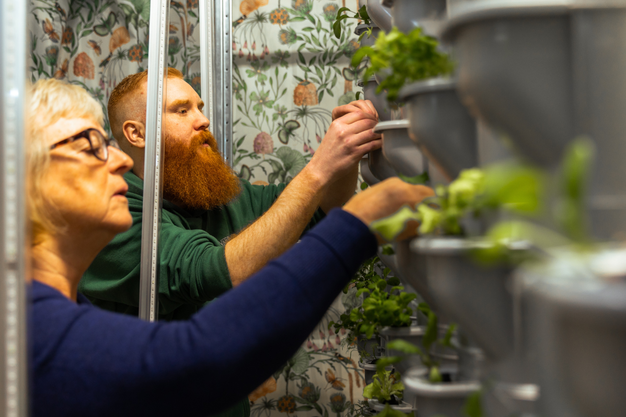 © Growpipes | HSB
Changing the meaning of success in indoor growing
In commercial vertical farming, success is usually measured in yield, labor efficiency, or return on investment, but Tilk uses a different benchmark. "Success for me is when they don't call me too much," he says with a laugh. "When it works, and they send photos of their harvest, that's success."
According to Growpipes, residents typically spend around 20 to 25 minutes per week on routine checks for systems holding roughly 100 to 200 plants. That includes topping up water, checking nutrient levels, and making small adjustments. Harvesting and cleaning take longer but happen less frequently.
Failures did occur, usually involving nutrient imbalances or blocked water flow. "But the difference here is that no one's livelihood depends on the harvest," Tilk says. "If it takes a week longer, it doesn't matter." In most cases, residents solved issues themselves or with light remote support. "One resident told me they felt more capable of handling problems than before. That learning process is part of the value."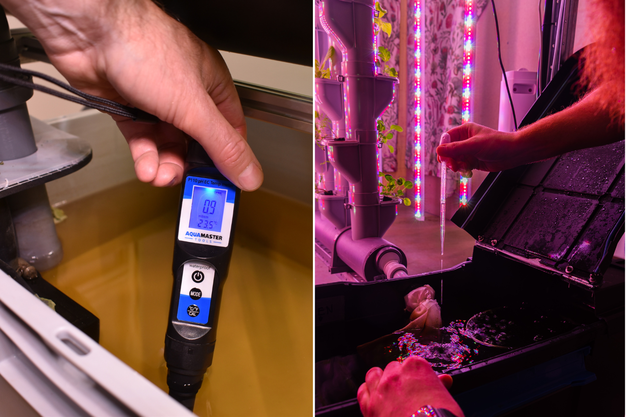 © Growpipes | HSB
Social outcomes observed by HSB
"Having a shared cultivation project to gather around turned out to be the opportunity many people needed. Meeting around an activity and working toward a common goal creates new encounters and a sense of community that bridges generations," says Madelaine Doufrix, Project Coordinator at HSB Living Lab.
HSB evaluated the project as both a technical pilot and a social initiative. "This wasn't something we evaluated ourselves," Tilk says. "HSB looked at it from a social perspective and came back saying they wanted to do more of this."
According to the housing cooperative, shared cultivation contributed to increased interaction among residents, particularly among people who had not previously engaged with one another. Meeting around a practical activity lowered social barriers, with conversations emerging around planting, harvesting, and cooking. In some buildings, residents organized informal harvest events or shared meals using the produce grown on site.
Loneliness, particularly among older residents, is a growing concern in Sweden. While hydroponics alone is not a solution, HSB found that shared projects like these created new routines and meeting points that complemented broader community initiatives.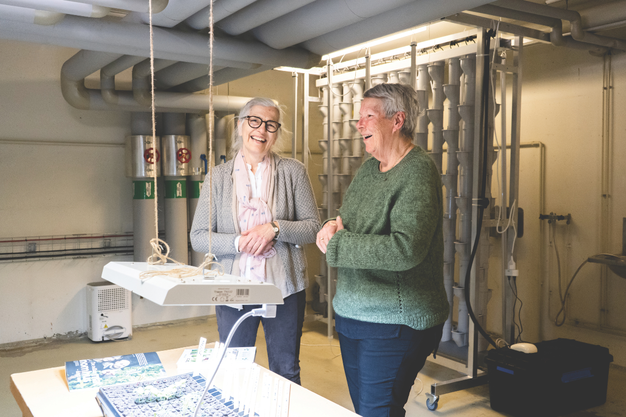 © Growpipes | HSB
Turning unused basements into shared infrastructure
One factor that made the model viable was the nature of Swedish housing stock. Many older apartment buildings contain unused basement spaces, often left behind after oil-based heating systems were phased out.
"There are limits, of course," Tilk says. "You need water, power, and basic ventilation. But in most buildings, those conditions already exist."
Temperature and humidity varied between sites, but residents adapted by choosing crops suited to local conditions. Leafy greens and herbs dominated cooler spaces, while fruiting crops were tested when conditions allowed. The emphasis was on adaptability rather than optimization.
A local model with wider relevance
Although the project is rooted in Sweden's cooperative housing model, Tilk believes the underlying principles extend beyond national borders. Systems designed for shared ownership, low maintenance, and failure tolerance could be adapted for schools, care facilities, and several other community settings.
After years in which indoor farming has often been defined by scale and capital intensity, Tilk sees renewed value in smaller, human-scale approaches. "Made in Sweden, grown by communities," he says. "It gives people a feeling of involvement. Not just in food production, but in something that belongs to everyone. Technology succeeds when it fits into people's lives."
For more information: 
Growpipes
Christer Tilk, CEO
[email protected]
www.growpipes.com
HSB Living Lab 
Madelaine Doufrix, Project Coordinator
[email protected]
www.hsb.se/in-english/hsb-living-lab