Just two years ago, the El Centenil farm, based next to the municipality of Villablanca, in Huelva, was a large empty plot where all agricultural activity had ceased due to the slow decline of Ence's pulp mill.
The picture has changed dramatically in recent months. Hundreds of rows of small trees with pointed leaves, still tied to their stakes, have given shape to a new landscape in the area. What is the secret of this radical transformation? The answer is simple: "We aim to produce the best avocados in Europe," says Estanislao Martínez.
This Sevillian entrepreneur is the president of Labs & Tech Holding Solea (whose main subsidiary is the AGQ Labs company). This firm bought the irrigation farm El Centenil (with 169 hectares) from Ence in February 2017, and only a few months later, it began converting the first 76 hectares in order to set up the most advanced avocado farm on the market. Labs & Tech Holding Solea has already purchased the plants necessary for a second stage, which will cover another forty hectares. This is how the Natural Crops project was born. The farm was renamed "El Centenil-California" and will require an investment of 12 million Euro.
Prospects
The goal of the initiative is to cover an unsatisfied demand. Europe currently consumes about 300,000 tons of avocados, and only produces 50,000. "Compared to countries like Mexico, Chile, Peru or the US, consumption in the Old Continent has remained insignificant, but it is growing at a rate of more than 20% per year," says Martínez. Most of the "green gold" that reaches the tables of European consumers arrives from the other side of the Atlantic. But avocados are a "climacteric" fruit; that is, "they continue ripening on the tree without spoiling, therefore reaching a better quality, but when they are harvested, this process stops. Since we are closer to Europe, we can supply fruit of a much higher quality than that coming from overseas (which has to be cut, therefore interrupting its ripening, 1-2 months earlier)."
The great difficulty of this project lies in the fact that the successful production of avocados in European countries entails huge challenges. "The fruit needs quality water supplied with precision, deep soils and a mild climate with no frosts or excessive heat." Spanish producers are mostly located in Velez-Málaga and Motril, where there are some 7,000 hectares, most of them with very fragmented family productions. "In El Centenil, in the southwest of Huelva, the conditions are ideal," stresses Estanislao Martínez, who believes that cultivation in the province of Huelva would be viable, at most, in an area of 10,000 hectares.
Technological factor
The key behind the El Centenil-California project is the technology used. AGQ Labs has carried out the technical management of plantations in Latin America and South Africa, monitoring and controlling the crops' nutrition. In Malaga, the average production is nine tons per hectare; "a figure that can increase to fifteen tons in those farms with more technified fertigation." In the case of El Centenil, this figure could exceed twenty tons per hectare after the fourth year. This is the usual yield achieved by American farms receiving advice from AGQ Labs.
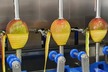
But there is even more technology to ensure that Huelva produces the best avocados in Europe. "We have set up a system of micro-sprinklers which prevents frosts if the temperature falls below zero degrees. And in summer, in cases of extreme heat, these can also lower the temperatures by almost ten degrees."
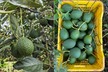
The small avocado trees of El Centenil-California will yield their first fruits next year.
Source: abc.es