The Turkish apple season has been extremely challenging, says Okan Imancer, co-founder and export manager for Turkish apple exporter The Fresh Apple: "For growers who had sufficient production and sold their fruit directly at harvest, it was actually a very profitable year. However, for exporters and traders, it has been a very difficult season. The main reason was the severe frost event that occurred in April last year, which heavily affected the central regions of Turkey. In many areas, production losses reached 80 to 90 per cent. Regions such as Karaman, Niğde, Kayseri, Nevşehir, and Konya were among the most affected."
The Isparta region, which is one of Turkey's key apple production areas, was affected much less compared to the central regions, Imancer explains. "A large share of the apples available on the market was sourced from orchards in Isparta. Overall, we estimate that Turkey's total apple production declined by around 50 to 60 per cent, and if we look specifically at high-quality export fruit, the reduction was even greater. Due to the limited supply, apple prices increased significantly and were more than double compared to a normal season."
"At the same time, we faced serious challenges in terms of fruit size and overall quality, which further limited export opportunities," Imancer continues. "Another factor that negatively affected exports was the exchange rate. Because the Turkish government has kept the currency relatively stable as part of its inflation-control policy, Turkish apples became very expensive in dollar terms, which significantly reduced their competitiveness in international markets."
 © The Fresh Apple
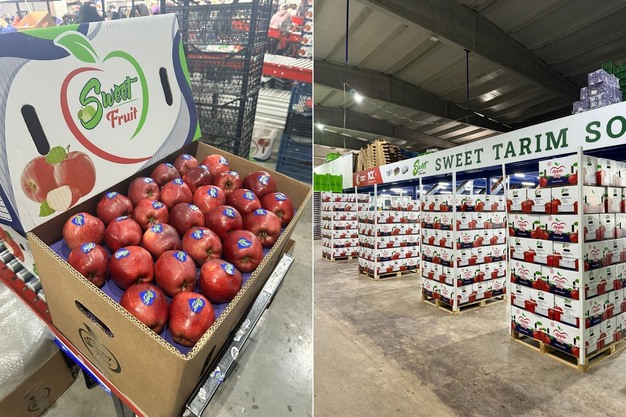
According to Imancer, availability was quite limited this season: "Because of the frost damage, the overall harvest was significantly lower, and finding large-size apples, especially 80 mm and above, was quite difficult. There was a general shortage across almost all varieties. Golden, Gala, Red Delicious, and other types were all affected, as the overall crop was much smaller than usual. We even saw apples being imported into Turkey this season. In particular, Granny Smith and Pink Lady apples were imported from countries such as Italy, Azerbaijan, and some Eastern European countries to supply the domestic market."
Imancer emphasizes that exporting apples from Turkey this season has been extremely difficult. "It's hard to express the decline as a percentage, but for many exporters, it has almost become impossible to compete in international markets. At the moment, India remains the most important export destination for Turkish apples. After India, key markets include Russia, Iraq, and several Middle Eastern countries."
However, the Indian market has been very weak for Turkish exporters this season, Imancer explains: "Turkish apples became too expensive for the Indian market, due to the limited crop and the exchange rate situation, which significantly reduced competitiveness. Iranian apples currently play a major role in the Indian market and are probably the most important factor determining price levels. In the past, the price difference between Turkish and Iranian apples was relatively small, and many importers still preferred Turkish apples because of their higher quality. But now, the price gap has become much wider, and with the current cost structure, it is very difficult for Turkish apples to compete with Iranian fruit in terms of volume."
 © The Fresh Apple
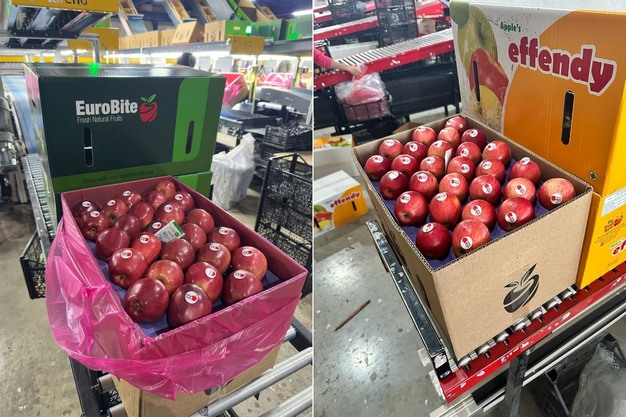
At the moment, export-quality apples are actually achieving better prices in the domestic market than in export markets. Imancer states. "Especially companies working with large supermarket chains are able to obtain relatively better prices. Large apples also sell well in traditional wholesale markets. The biggest challenge, however, is the large share of small-sized and lower-quality apples. Demand for these apples is very weak, and prices are extremely low. If the proportion of these lower-quality apples in the raw material is high, it becomes almost impossible for traders to make a profit."
"It's currently still somewhat unclear how much fruit remains in cold storage. However, it seems that the apples currently in storage are more than sufficient to cover domestic demand for the rest of the season," Imancer elaborates. "Because of this, we do not expect any significant price increases in the coming months. Export opportunities have been very limited from the beginning of the season. High production and storage costs pushed selling prices to levels that were simply not competitive in export markets. In fact, it would not be wrong to say that the Turkish apple export season almost ended before it even began this year.
Imancer is already looking forward to the next apple season: "We're quite optimistic about the upcoming season. The fruit bud formation on the trees currently looks very promising. If we do not experience a frost event similar to last year, we expect a significantly higher crop. If production returns to normal levels, orchard prices will likely be lower compared to this season. In that case, Turkey could once again become a strong and competitive exporter in the international apple market," he concludes.
For more information:
Okan İmançer
The Fresh Apple Dış Ticaret Ltd. Şti
Sweet Tarım Tic. San. Ltd. Şti
Tel: +90 544 595 03 91
[email protected]
[email protected]
www.thefreshapple.com
www.sweettarim.com