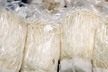
Korea's enoki mushroom production was about 76,562 tons in 2025, while exports fluctuate month to month. The country exported 705 tons in January 2025 and 499 tons in January 2026. In practice, domestic sales dominate, while exports are typically in the 'hundreds of tons per month' range, varying by season and market conditions.
Daemyung Farms operates a year-round bottle cultivation system with a stable production capacity of around 5,000 tons. Monthly output may vary depending on season and operational adjustments; however, the majority of the company's production is supplied to the domestic Korean market.
 © DAEMYUNG FARMS
"For us, among our export-designated production, approximately 25% is actually exported, which equals roughly 50 tons per month. Based on the average container loading capacity of 12–13 metric tons per container, this corresponds to approximately 4–5 containers monthly, and all remaining volume is supplied to the domestic market," explains Lily Jeong, Overseas Department Manager at Daemyung Farms.
The company's major destinations by export value include Australia (27.2%), the US (16.8%), the Netherlands (12.5%), and Canada (11.8%).
"Our exports are diversified across Oceania, North America, Europe, and Asia, with market-specific requirements for packaging, hygiene, and cold chain. We comply with each market's microbiological standards and packaging requirements."
 © DAEMYUNG FARMS
Domestic demand
Enoki is a staple item in Korea, widely used in hot pot, stir-fries, and salads, supporting a steady baseline demand. However, demand and pricing can weaken when consumption slows (macro downturn effects were cited in the 2025 market reporting). Demand is structurally stable, with short-term volatility by channel and consumer sentiment.
The growing process
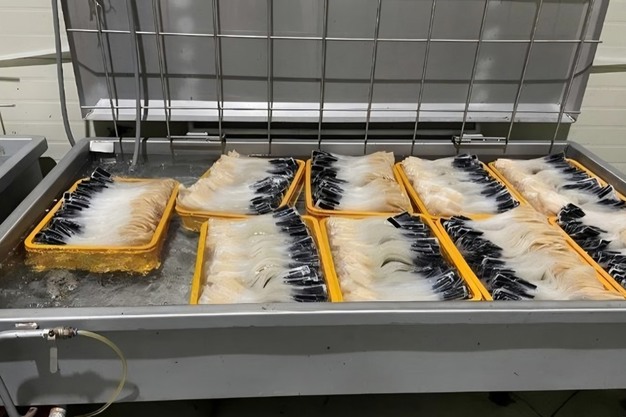
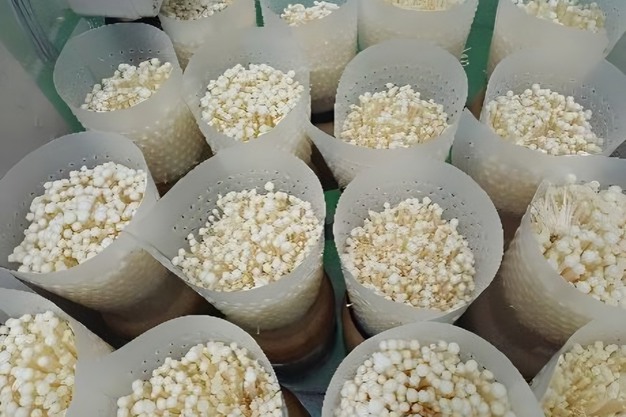
"We operate a controlled bottle cultivation system, including substrate preparation, sterilization, inoculation, incubation, fruiting, and harvesting. Export volumes are subject to additional grading and packaging control standards. There are 5 major key points of the process. Firstly, substrate prep (sawdust-based + nutrients) and filling bottles, then sterilization & cooling to reduce contamination and reach inoculation temperature. Then comes inoculation with spawn and incubation (mycelial growth), followed by fruiting induction with controlled temperature/humidity/CO₂ (environmental control strongly affects enoki quality). Lastly, it is time to harvest, grade, and pack, then cold-chain distribution begins."
 © DAEMYUNG FARMS
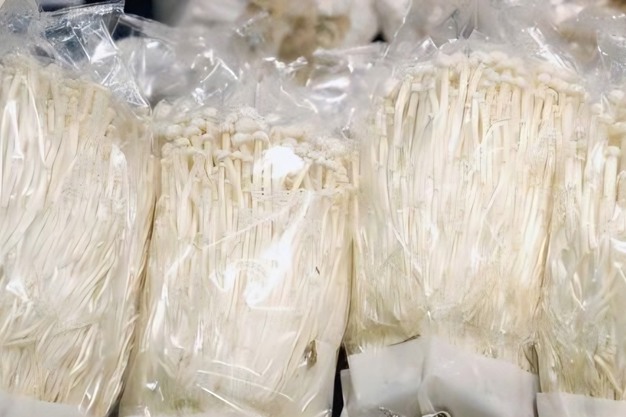
"All export shipments are maintained under strict cold-chain conditions. Depending on transit time and destination requirements, we provide standard PP packaging or vacuum/semi-vacuum options. Packaging is critical for enoki to manage moisture loss, browning, off-odours, and microbiological risk. For export, long-distance distribution often drives the use of vacuum or semi-vacuum packaging, and research has evaluated their impacts on quality and microbial safety. In practice, PP film/bag packaging + strict cold chain is baseline, with market-specific upgrades for labeling, traceability, COAs, and hygiene controls."
For more information:
Lily Jeong
Daemyung Farms Corporation
Tel. +82-70-8859-0672
Email: [email protected]