When a long-standing cutting supplier retired, it exposed a vulnerability that many ornamental growers recognize immediately. For crops with a small grower base, continuity cannot be taken for granted.
"Together with my father, Lex van Santen, we built our own propagation cell and vertical farm for Euphorbia Fulgens at his greenhouse in Maasdijk," says Pascal van Santen. "After our regular cutting supplier stopped operating, we decided to set up the entire cutting and propagation process ourselves, so we could fully control supply security, planning, and uniformity."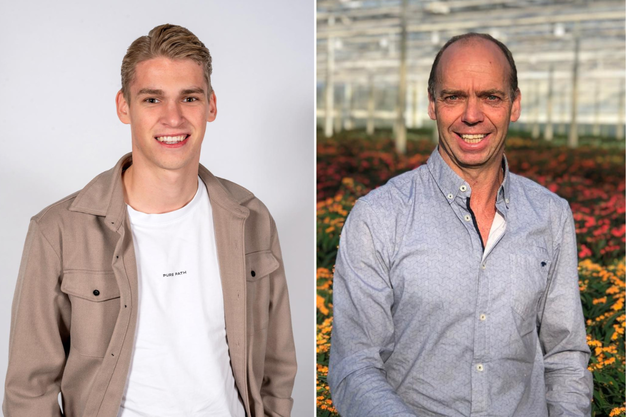 © Pascal van Santen
Pascal and Lex van Santen
A decision driven by the crop
"Fulgens is a relatively small product with only a limited number of growers, which makes it difficult to simply find another supplier, or outsource it externally," Pascal says.
Lex van Santen has been growing Fulgens for more than three decades, and the supplier's retirement marked a turning point. "If my father wanted to continue growing what he has been growing for the past thirty-five years, we needed to take control of the entire process ourselves. From the beginning, we agreed that we wanted to do this completely independently."
For Lex himself, the decision was not only about continuity, but about a long-standing connection to the crop itself. "My heart belongs to these flowers. I grew up with them," Lex van Santen says. "I thought, and still think, they're a beautiful product. It's a flower with quite a few instructions, but the challenge makes growing it the most wonderful thing there is."
Combining cultivation experience with engineering
The project became a collaboration across generations, built around complementary expertise. "With my father's many years of knowledge and experience, and my technical background, we combined those two worlds," Pascal says. "He approached it from the perspective of cultivation and practice, and I approached it from engineering, systems, and construction."
Although Pascal works professionally as a mechanical engineer, the project went beyond a technical exercise. "Next to my job, I had already been working on technical projects for myself, but building this together with my father made it even more special."
Starting small
Rather than scaling immediately, the project began with a controlled test phase. "In 2024, we placed a refrigerated container at our site and converted it into a test setup," Pascal says. "In this controlled environment, we could experiment with the most important variables that affect cuttings and propagation."
The setup used Danish carts with multi-layer LED lighting, allowing detailed observation of plant response. "One goal was central," he says. "Understanding what the plant needs to grow as uniformly as possible."
During this phase, the focus was on identifying sensitivities. "The focus was mainly on the right lighting settings, a stable temperature, controlled airflow, good air quality, and an even climate across all layers of the cart," Pascal explains. "This test period quickly gave us insight into what worked, what did not, and where the biggest sensitivities were."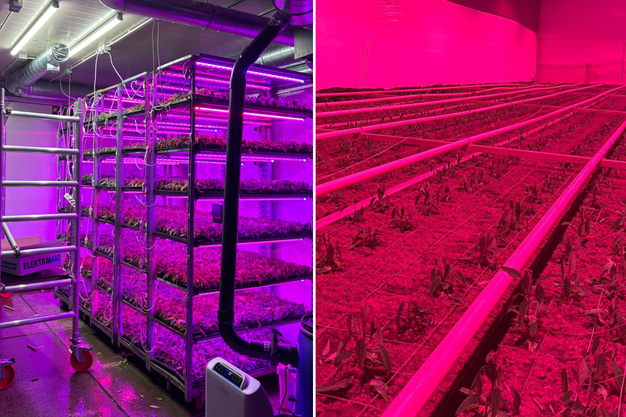 © Pascal van Santen
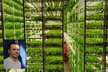
The propagation cell (left) and the first young plants to transition into the greenhouse (right)
Defining capacity before scaling up
Once the test phase clarified the required conditions, the next step was translating biology into planning. "We worked out how many layers a Danish cart could realistically carry, how many cuttings we would need within a certain time period, and how long a full propagation cycle takes. Based on that, we calculated the total capacity needed to keep the process running continuously and make the planning reliable."
Those calculations informed the move to a permanent solution. "This ultimately led to a larger, permanent climate cell where we can work with multiple rows of carts at the same time, and where the system is stable enough to run the full process consistently and in a controlled way."
Engineering the climate cell
The full build started at the beginning of 2025. "We poured a concrete floor and built a cold room of approximately eighty-five square meters on top of it," Pascal says. "From the start, the main principle was clear. The system had to focus on reliability, repeatability, and uniformity."
The layout centers on Danish carts arranged in multiple rows, with seven layers per cart. "With this setup, we reach a cultivation surface area of approximately 400 to 450 square meters," he says. Power distribution was deliberately simplified. "In the cell, we installed switched sockets that we can control based on our own settings," he explains. "Place the cart, plug it in, and it immediately runs as part of the system, without separate timers or manual switching."
Airflow and climate stability across all layers
For unrooted cuttings, stability is critical. "During the first stage, the cuttings have no roots and are therefore extremely sensitive to stress," Pascal says. "The main goal is to create the most even possible climate across all layers of the carts. Not only reaching the correct temperature or humidity, but distributing them evenly throughout the space."
Air is treated and redistributed gently. "Air is extracted, brought to the correct temperature via a heat exchanger and buffer, and humidity is actively adjusted. After that, the air is distributed back into the cell in a controlled and even way." This method avoids localized stress. "That is why the airflow system is designed so that the air is distributed via the walls between the layers and then moves gently and evenly through all layers. This prevents stagnant zones and minimizes differences in growth, stress, or drying out as much as possible."
Sensors continuously monitor conditions. "By measuring incoming and outgoing temperature, humidity, air velocity, and flow rates in the cooling system, we get real-time insight into what happens inside the cell. Based on these measurements, the system adjusts back to the target setpoints so the climate is not only good, but constant and reproducible."
Cost-conscious design instead of full automation
From the outset, automation was treated as a tool rather than a goal. "Not everything needs to be fully automated to achieve a good and reliable result. We continuously asked ourselves what is truly necessary to produce uniform cuttings, and what is nice to have." Logistics inside the cell remained manual by design. "Instead of a fully automatic transport system, we chose to work with Danish carts. This makes it easy to rotate weekly. New carts go in, and after about three weeks, the finished carts come out."
Lighting was approached with the same pragmatism. "Lighting is a major cost factor in a vertical farm," Pascal says. "I spent a lot of time determining the right LED setup. Enough light to control development, but without unnecessary energy consumption or investment in expensive brands that do not always deliver better results in practice."
The result was a custom solution. "We had the LED fixtures custom-made in China, matched to the Danish carts and the number of layers," he explains. "By designing custom plugs, all layers run on one single plug. Plug in one cart, and all layers are immediately active."
The financial impact was significant. "Including the full test phase, we ended up at roughly 16 percent of the square-meter cost of a fully automated vertical farm."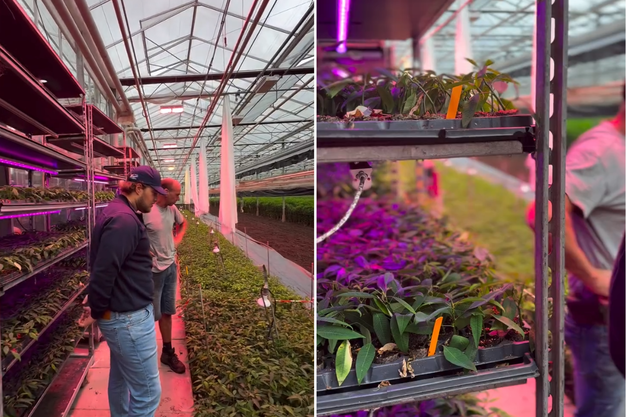 © Gijs Timmer | Kontikiflor
Lex van Santen with Gijs Timmer from Kontikiflor (left) and young Fulgens plants on Danish carts under LED lighting (right)
Closing the loop from mother plant to greenhouse
The propagation cell is part of a broader, closed-loop system. "We reserved a separate greenhouse section for the mother plants," Pascal says. "From these mother plants, we take the cuttings, which go into the plugs and then into the propagation cell."
A transitional area smooths the move back to the greenhouse. "We use this area as the link between the climate cell and the greenhouse," he explains. "Here, plants can acclimatize when they come out of the climate cell, so the transition happens in a controlled way, and the plants experience less stress."
First full year in-house
Last year marked the first full cycle entirely under their own control. "This was the first full year in which we worked completely with our own cuttings from our own mother plants, and the entire propagation process ran fully in-house," Pascal says.
The benefits were immediate, but so were the lessons. "It remains a challenging process because many factors influence uniformity and growth. Small differences in airflow, temperature, humidity, light, and microclimate can have a major impact."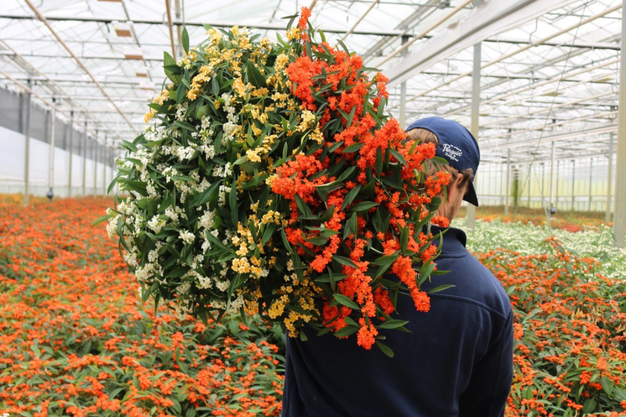 © Gijs Timmer | Kontikiflor
Continuous optimization, not an endpoint
The work is ongoing. "At this moment, our main focus is further optimizing the climate inside the cell, especially during the vulnerable first phase where the cuttings have no roots," Pascal says. "In that stage, stability is everything."
From his perspective, the project is not only a technical solution, but also a deliberate business decision. "Why I believe this is a strong and workable business case is because the focus is on the propagation stage of the plant. That first period is the most critical phase, because it's where the foundation for uniformity, quality, and reliability is built for the rest of the growing process," he says.
"In my view, it's not a solid business case to replace the sun entirely and run the full growth cycle under LED lighting, because financially that is difficult to justify. By creating the best possible start during propagation and then letting the plant continue growing in the greenhouse, you combine the best of both worlds. That's why I believe this approach has a future."
The project has also shaped his professional direction. "By designing, building, and optimizing the system myself every day, the motivation has only increased to keep developing in this direction," he says. "This does not feel like an endpoint, but the start of a path where so much is still possible."
For more information:
Bloemkwekerij Lex van Santen 
Pascal van Santen
+31 6 18933426
[email protected]
www.linkedin.com/in/pascal-van-santen
Lex van Santen
+31 6 20438542
[email protected]
www.euphorbiafulgens.com