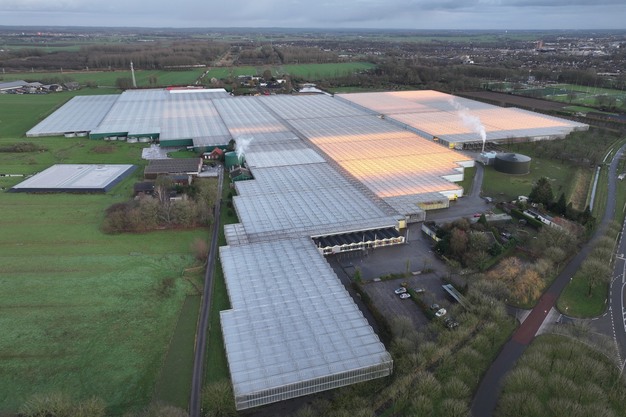
Plantenkwekerij Jongerius has officially been declared bankrupt. The largely organic nursery, which played an important role in the Dutch organic horticultural sector, unexpectedly announced on 31 October that it would cease all activities. What followed were weeks of uncertainty and unrest, with staff, growers, and customers left without clear information. For a long time, both a possible restart and a full bankruptcy remained options.
Jan Groen, chairman of sector organisation Bionext, says he heard about the bankruptcy from operations director Gertjan Lekkerkerker. "He sent me a message yesterday morning to say that the bankruptcy had been declared and that a court-appointed trustee would be assigned. Later that day, I received official confirmation."
According to Groen, the appointment of a trustee is an important step forward. "We finally have a formal legal point of contact. That makes it possible to have a proper discussion about what might still be feasible and what is not. Until now, that was extremely difficult, as both the owner and the management were unreachable."
Personnel is the first priority
According to Jan, the trustee's first priority is the employees. "It is a very sensitive moment, especially so close to Christmas. You want people to have clarity as quickly as possible. Right now, all the pressure is on helping the staff move forward and giving them some perspective."
Jan explains that the team is still present at the nursery and appears willing to look ahead together. "There is a strong willingness among the employees to stay together and explore whether a form of business succession could be possible. That is an important factor and certainly offers some hope."
When it comes to salary payments, Jan says wages were still paid up to the beginning of December. "After that, I have not received any signals that payments continued. The trustee has indicated that the UWV, the Dutch employee insurance agency, will be involved as quickly as possible."
Restart: Promising, but chances are low
Jan is cautious about the potential for a restart. "If you put it on a scale, the likelihood is just under fifty percent. But speed is essential, because the longer it takes, the smaller that chance becomes."
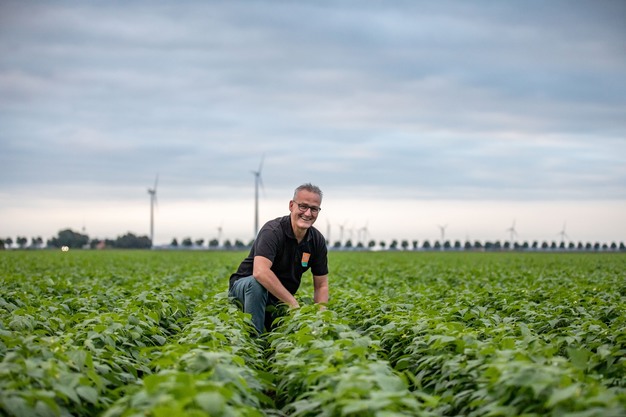 © Green Organics
According to Jan, the basic conditions for a restart are clear. "You need the buildings, the machinery, the people, and a solid understanding of the financial figures. You also need to know exactly what has gone bankrupt, because several limited companies are involved. That clarity needs to come quickly."
The coming weeks will be decisive, Jan says. "Between now and the second week of January, there has to be clarity. Otherwise, you miss the season. And in horticulture, missing the season makes a restart practically impossible."
Earlier bankruptcy dates announced for late November and 9 December did not go ahead. This was despite earlier statements by the operations director that suggested a bankruptcy was imminent, adding to the uncertainty felt throughout the horticultural community.
Owner unreachable
This only added to the uncertainty in the sector. With the court ruling, a trustee has now been appointed, Marco Guit of AMS Advocaten, and for the first time since the end of October, there is a formal legal point of contact. So far, owner Nico Jongerius has remained completely silent and has proven unreachable for any response.
The trustee is currently investigating the financial situation, mapping out the debts, and assessing whether parts of the company can be sold or whether a restart is still feasible. He told regional broadcaster RTV Utrecht that he has not yet been able to make contact with the management and does not have a complete list of employees. Staff members are therefore being asked to come forward so that the process for paying outstanding wages can be initiated. Several employees have already indicated that they have not received their salary for the past month.
Energy cut off and auction of machines canceled
As time passed, a restart began to look increasingly unlikely. Since the end of October, the company has been cut off from its energy supply due to a dispute with the energy provider. Ever since then, employees have been left in a state of uncertainty, while the nursery itself has effectively been at a standstill.
At the end of November, an enforcement auction took place, but this was adjusted at the very last moment, allowing crucial machines to remain at the Houten site. What will now happen to the greenhouses, the workforce, and the machinery appears to rest largely in the hands of the trustee.
Jan does not see the lack of contact with the owner as decisive for the chances of a restart. "In the end, what really matters is whether there is a party with the knowledge, the resources, and the willingness to continue with the people who are there. That is far more important than the question of whether the owner actively cooperates."
The market has already absorbed a lot
In the meantime, a large part of the market has not been standing still. "At Bionext, we focused early on the key question: where are the gaps, and who can fill them?" Jan explains. "Other plant nurseries, including ones in Germany and Belgium, have scaled up their operations. A significant part of the demand has already been covered."
In the short term, more and more companies have made their own choices for organic propagators. Some found space with fellow propagators, while others decided to start propagating themselves, sometimes independently and sometimes in cooperation with other growers. Within the organic sector, work is also underway on a long-term, sustainable solution to replace the role Jongerius once played. One option being discussed is a cooperative structure, similar to the model recently suggested by organic supermarket chain Odin (link in Dutch).
No one has stood still
According to Jan, the sector is showing a great deal of entrepreneurship. "No one has been sitting still. Everyone is looking at what they can do within their own possibilities. That really shows how strong the sense of solidarity is within the organic sector."
If there is no restart, Jan does not expect the sector to be thrown into chaos. "In that case, the market will absorb it. There is enough entrepreneurship in the organic sector to handle this. It is not ideal, but it is also not a disaster."
However, he does see risks for smaller growers. "Especially smaller initiatives, such as CSA farms and community-based projects like Herenboeren, depend on accessible organic plant propagation. For them, a restart would truly make a difference."
Causes mainly company-specific
According to Jan, it is still too early to say with certainty what caused the bankruptcy. "I think this is mainly company-specific. The last publicly available annual accounts date back to 2021, and since then, there has been no up-to-date insight into the figures. Without that transparency, it becomes very difficult for anyone to think along or offer support."
Rising costs, such as energy prices, may have played a role, but Jan does not see them as the full explanation. "I do not get the impression that this says anything about the position of organic horticulture compared to conventional production."
What stands out most to Jan is that no call for help was made. "That may well be the most important lesson here. When entrepreneurs feel the pressure building, they need to raise the alarm in time. There are banks, advisors, and sector organisations willing to think along, but as an entrepreneur you have to be proactive, make contact, and be open about the situation."
Importance of chain collaboration
The most important lesson Jan takes from this situation is the value of cooperation across the entire supply chain. "Organic agriculture requires commitment at every level, from producer to customer. If you think you can solve everything on your own, it becomes very difficult."
Despite everything, Jan remains positive about the resilience of the sector. "The organic sector will continue, with or without Jongerius. Bankruptcies have always been part of business life. What you see time and again is that the sector picks itself up." For now, Jan says, the strongest feeling is hope for quick clarity. "Not just for the market, but especially for the people working there. They deserve a new perspective as soon as possible."
For more information:
Jan Groen 
Bionext
Bennekomseweg 43
6717 LL Ede
Tel: +31(0)30-2339970
[email protected]
bionext.nl