For more than two decades, the High Atlas Foundation has worked to strengthen rural livelihoods in Morocco by helping smallholder farmers access the tools, technology, and resources they need to thrive. Co-founded by former Peace Corps volunteers in 2000, the Moroccan nonprofit has grown into a network of nearly 20,000 farmers across the country, focusing on sustainable, community-driven agriculture.
"We support the economic integration of farmers to access better technology but also better resources, water, and energy," says Rim Baji, Chief Partnerships Officer at the High Atlas Foundation. "The larger, better-resourced farms already have access to market and to financing, but they don't necessarily contribute to enhancing the livelihoods of the majority. We aim to target that majority."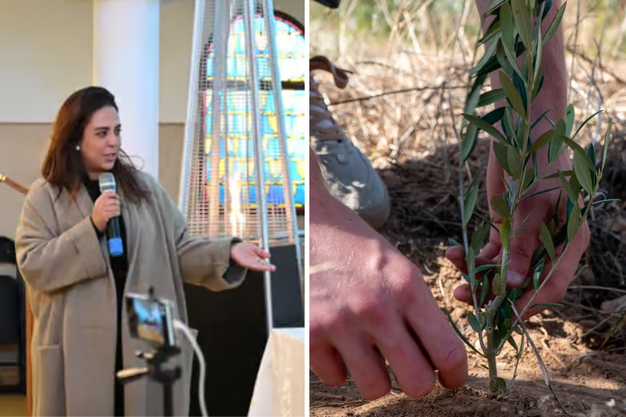 © High Atlas Foundation
Expanding access through demonstration and shared learning
Most of the Foundation's work has centered on tree planting, open-field cultivation, and greenhouse production, particularly in its sapling nursery. As it expands into new regions of Africa, HAF is exploring how controlled environment technologies could complement its existing model. Baji explains that vertical farming, often seen as a high-tech urban solution, can also serve rural communities when adapted to local contexts.
"We want to bring other technology because vertical farming can give a village a warehouse where everyone contributes and benefits," she says. "For farmers who are illiterate or have never seen such systems, it is important to have a model farm where they can see the technology functioning. Once they do, they can imagine how to apply it."
HAF's proposed Model Farm aims to provide that bridge: a low- to medium-tech demonstration site that combines vertical systems, greenhouses, and shade houses designed for replication across Morocco's varied climates. "It will be designed for the ecosystem needs, not one fit for all," Baji explains. "We will start by mapping and screening the site, then setting it up with technologies that farmers can copy and adapt."
Vertical farming as a propagation tool
One of the Foundation's most promising use cases is propagation. HAF operates nine tree nurseries that collectively produce about four million saplings each year. These include indigenous species such as olive, carob, almond, and pomegranate that are distributed to farmers to improve food security and generate income.
"Propagation is an amazing way for us to use vertical farming sustainably without competing with normal crops," says Baji. "We produce trees that generate food and revenue for families. With vertical farming, we can grow stronger saplings that have a better survival rate once planted in the field."
Rather than positioning vertical farms as competitors to open-field cultivation, Baji views them as complementary. "We do not want to compete with Morocco's excellent open-field tomatoes or other crops. Vertical farming can complete the full value chain. It preserves resources, uses less water, and adds precision where it is most effective." © High Atlas Foundation
A shared-economy model for rural technology
HAF's approach favors shared infrastructure over individual ownership. "If one farmer builds a vertical farm, it may not be economically feasible," says Baji. "But if it works in a shared-economy model, used as a propagation and training site for many farmers, it makes sense. They can share the costs and enjoy the benefits."
This collaborative model aligns with HAF's broader mission of community-led development. "Our farmers are not agronomists or economists; they are people who feel the earth," she explains. "When they see their farms functioning, their children who left for the cities often return. It becomes a story of economic integration and stability."
Revitalizing rural life through technology
Agriculture remains the backbone of Morocco's economy, yet rural areas face challenges, including an aging farmer population, limited resources, and youth migration. HAF's introduction of new technologies aims to improve productivity and make farming more attractive to younger generations.
"Developing farming skills is an integration tool," says Baji. "If young people see that farms can generate real revenue through technology, they come back. Vertical farming also attracts those interested in innovation and data. It changes the image of what a farmer can be."
The next step is to formalize the Model Farm and seek partnerships for implementation. "We want to have some exposure for fundraising," Baji adds. "The High Atlas Foundation has a strong record over twenty years, and we want to build on that to show how new models can serve the needs of rural farmers."
For more information:
High Atlas Foundation 
Rim Baji, Chief Partnerships Officer
[email protected]
www.highatlasfoundation.org