Making agriculture as profitable an activity as possible; to this end, the Experimental Station La Mayora de Algarrobo and growers of the region have long been testing and experimenting with different crops in an attempt to find varieties that are suitable for the area and allow the opening of new markets. Thanks to this labour of research, La Mayora managed to introduce almost half a century ago what today are flagship crops for the province in terms of economic importance. This is the case of the tropical sector, which in 2013 alone achieved a turnover of around 80 million Euro.
The spectacular growth of mangoes
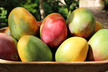
Thanks to the concern shown more than three decades ago by growers like Eduardo Braum, nowadays Axarquia has become Europe's largest mango producer. Braum says that when he started cultivating mangoes, many other growers often said he was mad. Today, however, mangoes are one of the region's favourite crops. Currently there are over 3,500 hectares in production that yield around 20,000 tonnes. Some suggest that in some years the production will be greater than that of avocados. The province has almost exclusively planted the Osteen variety, which makes it possible to extend the harvest period.
Promoter of the introduction of other prominent crops in Andalusia, such as strawberries, La Mayora has been experimenting for some time with crops and varieties which, in principle, have a high commercial interest. And it does so with the dual purpose of allowing the grower not to depend solely on a single-crop and to have alternatives for diversification.
Some farmers even take time cultivating bananas in greenhouses
According to the research professor of experimental station, Iñaki Homaza, La Mayora spent years conducting trials with lychee and longan, two species are very close to the genetic level cultivated especially in southern China and northern Vietnam and are very demanded by the Asian population in Europe. "In both cases show great fruit production. Of the two, the longan is the latest in the region.'re Much more productive than the lychee and fruit on the tree can hold uncollected without diminished quality you see" , Hormaza explains.
La Axarquia testing new crops to open future markets
Studies are also underway with other tropical species such as pitaya and carambola, with the latter being more advanced. The carambola is an evergreen shrub native of South East Asia that can reach a height of about five metres. Its fruit is used in salads and it has a juicy flesh, slightly fibrous and acid. It contains vitamin A and C, phosphorus and potassium. "The fruit that reaches Europe comes from third countries. We know how to produce it, but growers have not yet noticed it," laments Hormaza.
Regarding pitayas, the researcher stresses that what little there is in Europe comes from imports. The plant is native to America and belongs to the cactus family. It produces large flowers that open overnight. In the wild they are pollinated by bats, and outside their usual areas they have to be manually pollinated to ensure production. "It does not require much water and its production costs are not high," points out Hormaza.
But in the Axarquia region there are also growers who are constantly looking for new varieties of commercial interest to the sector. This is the case of the President of the Association for the Development of Employment Generating Initiatives for La Axarquia, Leovigildo Martín, one of the promoters of the introduction in the region of stevia, a herbal shrub, whose leaf is up to 300 times sweeter sugar, not fattening and suitable for diabetics, and more profitable than tomatoes or peppers. Today there are a dozen growers cultivating it.
His latest test involves the moringa, an economically valuable species from South Asia. It is a plant which, as stated even by the FAO, has many uses, as its leaves, roots and unripe pods can be eaten as vegetables. Additionally, all parts of the tree (bark, pods, leaves, nuts, seeds, tubers, roots and flowers) are edible. According to Martin, its cultivation is even more profitable than that of stevia. The Experimental Station La Mayora has presented a project for its study, given the interest shown by some African countries.
Another very active grower is Eloy Cuadra, from Algarrobo, which has been cultivating bananas in greenhouses for some time, which he assures to be even more profitable than mangoes. "Now I'm trying to plant some soursop trees, which they say is about 100 times more effective against cancer than chemotherapy," he says. Also known as graviola, this evergreen tree is native to tropical regions and produces a long and thorny green fruit whose pulp is edible.
Cuadra has also conducted some tests, although unsuccessful, with the breadfruit tree.
Source: diariosur.es