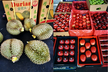
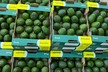
The tropical fruit sector, especially when it comes to mangoes and avocados, is experiencing an unprecedented expansion phase in the Italian and European markets. The data presented by Pietro Mauro, Director of Fruitimprese, within "Mango and Avocado Explosion" (a focus that discussed the two tropical products during the three days of the Macfrut fair), outlines a picture of long-term structural growth despite some annual fluctuations in export volumes.
 © Maria Luigia Brusco | FreshPlaza.com
Pietro Mauro, Director of Fruitimprese
Mauro underlines a fundamental point for tropical fruit: the drop in the value of exports (-10.2%, from 152 to 136 million Euros) is less marked than the drop in volumes (-18.1%). "This indicates a 'premiumisation' of the remaining Italian supply. We are exporting less, but at higher average prices. The main cause of the drop is not a loss of competitiveness, but rather an extremely toned-down domestic demand that absorbs domestic production, preventing the creation of the 'critical mass' necessary to permanently preside over foreign markets."
In the two-year period 2024-2025, there will be an increase in the total value of Italian fruit and vegetable imports (+14.9%), with tropical fruit maintaining a predominant role in purchases from abroad, exceeding one million tonnes per year.
The analysis of historical data confirms a trend of constant growth in the quantity imported from 2021 to 2025, with economic values stabilising. "In 2021, the figure was 1,053,661 tonnes, while in 2025 it was 1,126,533 tonnes. After peaking at 148,936 tonnes in 2024, exports dropped to 122,029 tonnes in 2025, indicating greater retention of the product for domestic consumption.
 © Fruitimprese
Focus on the mango market in the EU
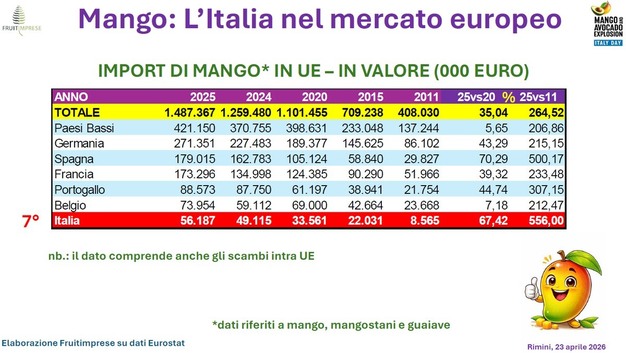
Mangoes are the symbol of the tropical 'explosion' in Europe. The analysis of 2011-2025 data shows how Italy is rapidly climbing the consumption hierarchy. In 2025, mango imports generated a value of EUR 56.18 million, up from just EUR 8.5 million in 2011.
The European Union relies on a diversified network of global suppliers to meet mango demand. The European market is mainly supplied by Brazil (historical leader in supplies), Peru (second strategic partner), and other relevant suppliers such as the Ivory Coast, the Dominican Republic, and Israel.
"Italy is the 7th European mango importer, a category that includes mangosteens and guavas, positioning itself behind logistics giants such as the Netherlands and mass consumption markets such as Germany and Spain. Between 2011 and 2025, mango imports to Italy grew by 412.47% in quantity and 556% in value," explained Mauro.
 © Fruitimprese
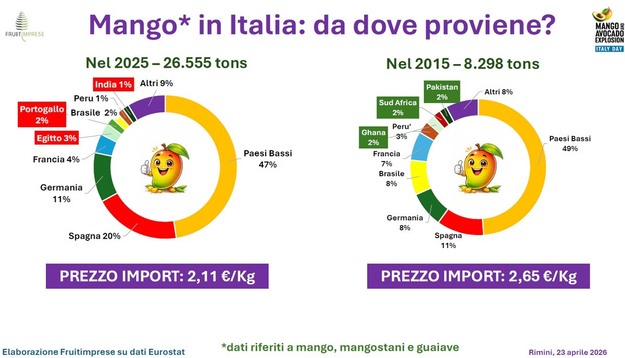
The Netherlands acts as the main logistical hub, handling about 47% of the total imports. Spain follows with 20%. Germany (11%) and France (4%) represent significant end markets. New players such as Egypt (3%) are beginning to erode shares from traditional suppliers.
Avocados: Italy used to be almost dependent on the Netherlands, not anymore
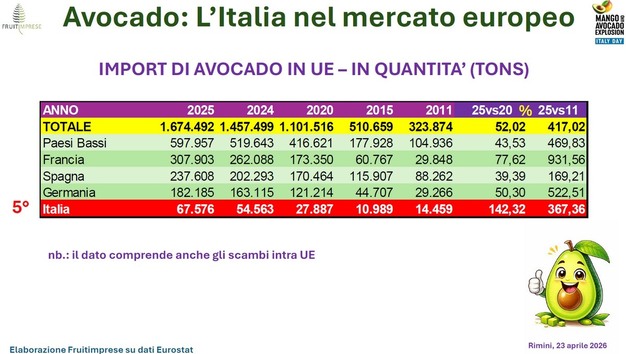
Italy plays a major role in the European avocado market, firmly ranking 5th in the European Union for both imported volumes and generated turnover. In 2025, Italy imported 67,576 tonnes of avocados, registering an impressive increase of 142.32% compared to 2020 and 367.36% compared to 2011, when it imported only 14,459 tonnes. In value terms, imports reached 171.8 million in 2025, marking a record leap of 700.32% compared to 21.4 million in 2011.
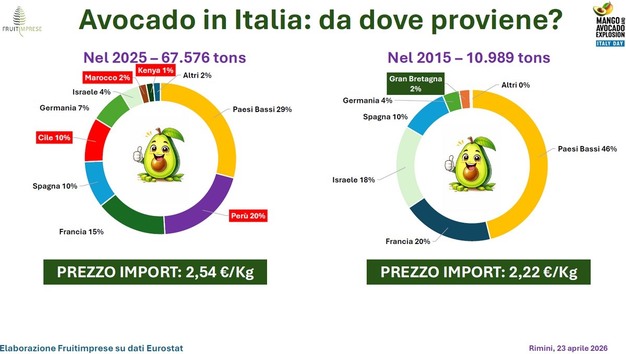
The main avocado suppliers for Italy are the Netherlands (29%), Europe's primary logistics hub, followed directly by producing nations and European partners such as Peru (20%), France (15%), Spain (10%), and Chile (10%). Import sources have diversified from previous years, when Italy depended almost half on the Netherlands (46%) and a substantial share on Israel (18%).
 © Fruitimprese
Besides importing, Italy actively participates in exports to Europe. In 2025, it exported 4,195 tonnes worth EUR 11.2 million. These numbers represent 6% of the import amount, and the product is mainly destined for key markets such as France (15%), Spain (14%), and Slovenia (14%).
Driving the imports is an explosive domestic demand. Italian household purchases for domestic consumption reached 27,551 tonnes in 2025, up 39% from the previous year. This translates into an expenditure exceeding EUR 169 million (+40% compared to 2024), with an average retail price of 6.14 €/kg.
 © Fruitimprese
At the end of his speech, the Fruitimprese director pointed out that it is essential to pay attention to any forms of misleading or disparaging advertising against foreign products. "In addition to distorting consumer perception and damaging competition, such practices are punishable by law," he said.