Brazil exported more than 194,000 tons of melons between August 2025 and January 2026, up 6% from the 183,000 tons shipped in the same period of the previous season. According to the Center for Advanced Studies on Applied Economics (Cepea), growers in Rio Grande do Norte and Ceará brought forward harvests ahead of the January to March rainy season, supporting export volumes in the first half of the season.
The Netherlands was the main destination, accounting for 43.34% of shipments, followed by Spain with 24.88%, the United Kingdom with 23.16%, and Canada with 3.27%. These markets were also the leading buyers during the same period of the previous season.
Rio Grande do Norte remains an important export region. Data from the Secretariat of Foreign Trade (Secex) show the state exported fruit worth US$269.5 million in 2025, a 33% increase from 2024. It ranked second among Brazil's fruit-exporting states, behind Pernambuco.
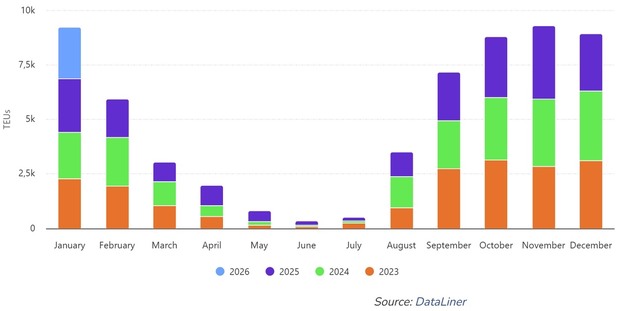 © DataLiner
For the 2025/26 season, exports through the Port of Natal could reach up to 300,000 tons of fresh fruit, which would double the previous season's volume. Port infrastructure investments are also underway. In August 2025, during the Expofruit trade fair in Mossoró, Governor Fátima Bezerra announced federal funding of 130 million reais (US$26 million) for upgrades.
"These investments were requested mainly by the fruit sector in Mossoró and Baraúna. The works are already underway, including dredging, bridge protections, quay reinforcements, and warehouse upgrades, as well as the installation of a photovoltaic plant," the governor said. "The roughly 130 million reais in investments will improve logistics and navigational capacity, allowing us to expand exports, particularly in the fruit sector. Currently, part of this production is shipped through the ports of Pecém, Suape, and even Cabedelo."
According to Carlo Porro, chief executive of Agrícola Famosa, using a dedicated port and vessel benefits transport time and product quality. "The advantages of having a dedicated port and, above all, a dedicated vessel are fruit quality and transit time. The ship does not call at other ports, so the fruit arrives faster and in ideal condition. That makes a big difference for quality."
Europe remains the main destination for fruit exports from Rio Grande do Norte, accounting for about 90% of shipments, although the sector is also exploring additional markets, including China.
Competition from Central America may influence shipments during the February to July period. Export volumes from Costa Rica and Guatemala are expected to increase following expanded planting areas and higher production forecasts. According to Cepea researchers, this could affect Brazilian shipments during the April to June off-season window.
Source: Notícias Agrícolas / DatamarNews