External trade in fruit and vegetable products holds a strategic position in Uzbekistan's agricultural sector and food security framework. At the same time, expanding international trade volumes are contributing to a higher carbon footprint, according to the EastFruit project. The main emission sources are long-distance transport, refrigeration use, and packaging. In the context of rising temperatures, water scarcity, extreme weather events, and climate-related trade instruments such as carbon taxes, EU CBAM, and green certification, monitoring CO2 emissions in the fruit and vegetable trade is gaining relevance.
 © EastFruit
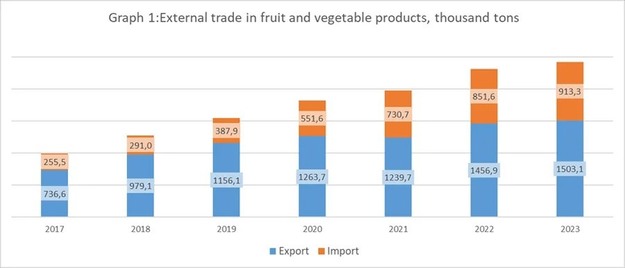
Between 2017 and 2023, Uzbekistan's fruit and vegetable trade turnover in physical terms increased 2.4 times to 2.4 million tons. Export volumes rose from 736.6 thousand tons to 1.5 million tons, representing a 2.0 times increase. Imports grew from 255.5 thousand tons to 913.3 thousand tons, or 3.6 times over the same period.
To assess greenhouse gas emissions expressed in CO2 equivalent, experts applied a methodology aligned with ISO 14083:2023, adopted by the European Union in April 2024. Using this framework and general trade data, emission dynamics for exports and imports were calculated for the 2017 to 2023 period.
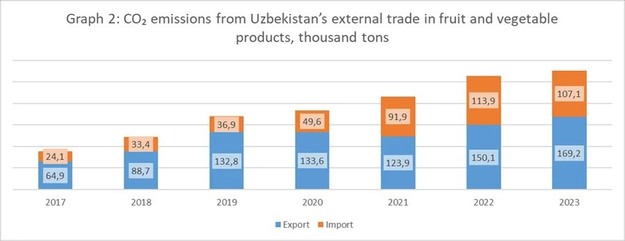
Results indicate that annual CO2 emissions linked to Uzbekistan's foreign fruit and vegetable trade increased 3.1 times, from 89.0 thousand tons to 276.3 thousand tons. Emissions from exports rose 2.6 times, from 64.9 thousand tons to 169.2 thousand tons. Import-related emissions increased 4.5 times, from 24.1 thousand tons to 107.1 thousand tons.
 © EastFruit
The most carbon-intensive categories include fresh fruits, berries, tomatoes, bananas, mandarins, and frozen products requiring refrigeration and, in certain cases, air freight. In contrast, potatoes, onions, and dried products are associated with lower emission levels due to reduced cooling requirements and transport intensity.
Additional emission growth factors include border delays affecting refrigerated transport and limited optimization of logistics routes. As trade volumes continue to expand, emissions are tracking upward, underlining the link between physical export growth and transport-related carbon output within Uzbekistan's fruit and vegetable sector.
Source: EastFruit