When traditional synthetic pesticides decrease in cost as generics enter the market, why wouldn't growers use more of them? What would motivate them to adopt biological products in their pest management strategies? When consumer markets are not demanding reduced residues on food, growers may feel little pressure to adjust their pest management practices to incorporate biologicals - especially if it costs more than using conventional chemicals.
"In our opinion," says Sean Thackeray, chief commercial officer of River Bioscience and XSIT, "the way to encourage adoption is to demonstrate field performance and make it affordable. Our goal is that if you move toward a more biological programme, it should not cost more than your standard chemical programme."
Thackeray, an entomologist by training, explains that River Bioscience and XSIT, which grew from decades of intellectual property within South Africa's citrus industry, are guided by the principle of fair value. "A biological product needs to be priced so that a grower can still use it in an integrated programme. There is no silver bullet in integrated pest management."
 © River BioScience
One of the largest insect-rearing structures in Africa
River Bioscience's baculovirus-based products are conceived, developed, and produced entirely in South Africa. "We are a leader in sustainable agriculture within the Southern African market, with local technology that has global relevance."
The company owns one of the two virus manufacturing plants in Africa, as well as one of the continent's largest insect-rearing facilities. "Virus production, along with the rearing and sterilization of false codling moth and the rearing of other lepidoptera, are our core competencies. We offer the largest range of products for the biological management of FCM."
The River Bioscience portfolio for managing FCM includes mating disruption, three different virus products, an egg parasitoid, and entomopathogenic nematodes. To guide growers in timing applications, monitoring networks have been established in various production areas to support informed spraying decisions.
"Over the past decade, the use of baculovirus products in certain markets has increased significantly. For example, virus applications for FCM management have expanded by almost 300% in treated areas over this period. Two new products containing the active ingredient CrpeNPV were launched by River Bioscience for use in macadamias, litchis and pome fruits a few seasons ago, and we've seen excellent market adoption and feedback."
He continues: "We have active registrations in South Africa, Zimbabwe, Malawi, Tanzania, Ethiopia, and Kenya, with registrations pending in Europe and North America. In Kenya and Ethiopia, the flower market is probably the biggest opportunity right now because false codling moth is a major challenge for export roses into Europe. As registrations come through in new territories, especially Europe and North America, we fully appreciate that we'll be the new players in the market. That's why we've invested in a world-class research and development team, as well as quality management systems and infrastructure, to ensure products of the highest standard. Our virus production plant is ISO 9001 accredited, and our viruses also carry organic certifications."
Lowering the cost of FCM biocontrol
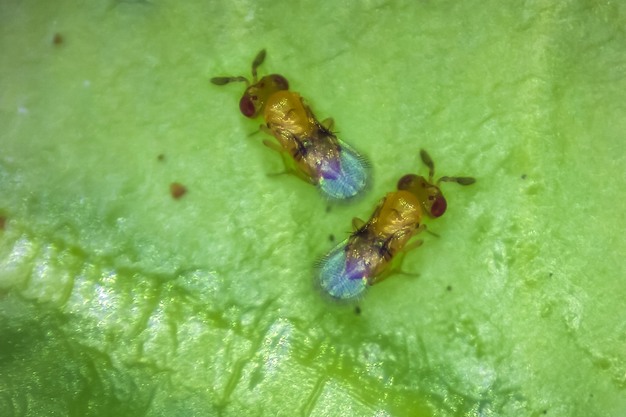
The parasitoid wasp Trichogrammatoidea cryptophlebiae targets the eggs of tortricid pests, including FCM, macadamia nut borer, litchi moth, codling moth, and Lobesia vanillana.
"Back in the 1970s," Thackeray notes, "leading citrus farms were rearing their own Trichogrammatoidea populations for biocontrol. Over time, this practice declined, and commercial rearing drove up the cost for growers significantly."
 © River BioScience
Parasitoid wasp Trichogrammatoidea cryptophlebiae
"With XSIT, our core expertise is obviously rearing false codling moth. We realized we could use excess egg production from the SIT [sterile insect technique] facility. The facility also has a cobalt radiation source to sterilize egg sheets - a game-changer for parasitoid production. The scale of FCM egg production, combined with the radiation source, allowed us to significantly reduce the cost of Trichogrammatoidea production and transport, opening markets that previously couldn't access the product due to price sensitivity."
The greatest opportunity for growers to derive value from Trichogramma, he says, is in the macadamia market during summer. "Citrus growers are already using extensive mating disruption and virus sprays, with more rigorous chemical programmes than macadamias. Over the past three years, we've been able to reposition Trichogramma pricing accordingly."
Determining the optimal ratio of predator parasitoid to prey species is critical. "Then we need to scale these calculations from the lab to large-scale production—science is never left behind. We operate in a competitive environment, not only against other biologicals but also against synthetic chemistry. Our aim is to offer growers a complete solution within our portfolio."
For more information: Sean Thackeray
River Bioscience & XSIT
Tel: +27 41 373 1409
Email: [email protected]
https://riverbioscience.co.za/
https://xsit.co.za/