In vegetable processing, a few millimetres can mean the difference between yield and waste. For years, processors accepted high product loss when removing cores from vegetables like iceberg lettuce. According to Will Uijting of QING, that was largely due to the limits of traditional vision systems. "Most conventional systems are based on assumptions and averages. But food products are anything but average."
 © Qing - Extractacore LTD
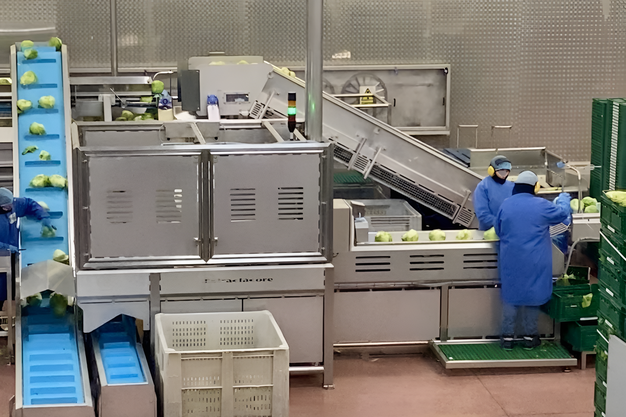
A collaboration between Dutch automation specialist QING and British machine builder Extractacore has demonstrated how AI-driven vision can dramatically improve results. By integrating 3D AI vision into an existing cutting line, waste was reduced from 30–40% to just 3–5%, without compromising speed or reliability.
From assumptions to understanding
Extractacore's machines are widely used for automated core removal. However, natural product variation made precise cutting difficult. "To guarantee full core removal, machines tended to cut wider than necessary," explains Letti Barber of Extractacore. "That ensured safety and consistency, but it also meant losing usable product."
 © Qing - Extractacore LTD
The breakthrough came when Extractacore realised the limitation wasn't mechanical, but intellectual. "We needed a system that could really understand where the core is, not just guess based on averages," Letti says.
That search led to QING and its STAQ platform (See, Think, Act), which integrates image capture, AI-based decision-making, and robotic execution. Crucially, the existing robot system remained unchanged. "We improved the 'See' and 'Think' layers while keeping the 'Act' intact," says Will. This reduced implementation barriers for customers.
3D AI vision in action
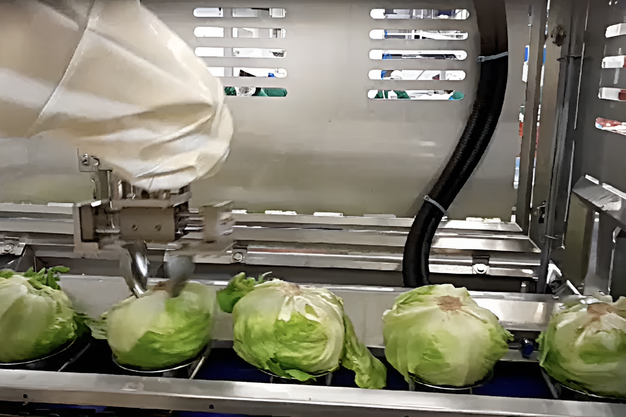
The upgrade replaced traditional 2D colour detection with AI-supported 3D vision, enabling the system to determine the core's exact position, orientation, and depth. "You're no longer guessing — you know exactly where the core is," Will explains.
 © Qing - Extractacore LTD
The system processes approximately one product per second, matching industrial throughput demands. Reliability was essential. "AI must reduce variability, not introduce it," Will notes. From the operator's perspective, the machine functions like a standard system — just with far greater precision.
Beyond waste reduction
For processors, cutting waste to 3–5% directly improves yield and margins. "Once customers see the numbers, the conversation changes," Letti says. But the benefits extend further: more consistent performance, less process stress, and valuable production data.
 © Qing - Extractacore LTD
The system continuously collects data on product characteristics and cutting accuracy. "When you start measuring variation instead of ignoring it, you gain a completely new view of your process," Will adds.
Although first applied to iceberg lettuce, the solution is scalable to other vegetables and core-removal processes. Both companies expect AI-driven vision to become standard in vegetable processing.
"Variability isn't the enemy," Will concludes. "Ignoring it is. AI allows you to work with natural products on their own terms."
For more information:
QING
Postbus 882
6800 AW Arnhem
Tel: +31 (0) 85 049 9600
[email protected]
www.qing.nl
Extractacore LTD
Tel: +44 (0) 7903270915
[email protected]
www.extractacoreltd.com