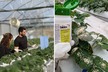
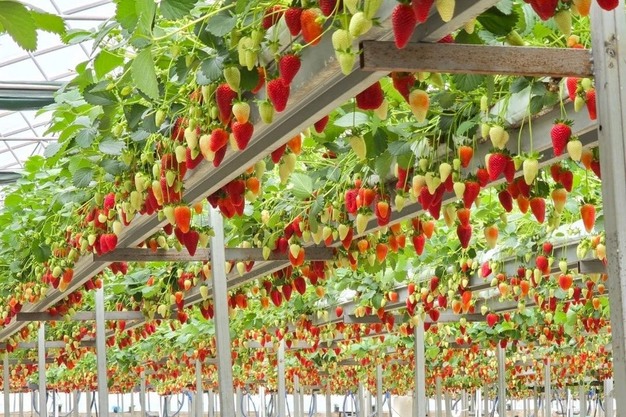
Greenhouse strawberry production is increasing in both Türkiye and the United States as growers seek year-round production and reduced reliance on chemical inputs. Claros Farm operates in both countries, conducting research-based greenhouse production in Türkiye and technology development activities in the United States. Its R&D work focuses on soilless cultivation, biological pest management, and organic production systems for greenhouse environments.
R&D background and production focus
In Turkey, Claros Farm's primary research facilities are located in İzmir, one of the country's most advanced regions for agricultural production, according to Agricultural Engineer Birgül Albayrak. "Our greenhouse and laboratory serve as a controlled environment for developing and testing organic and chemical-free production models."
The company combines greenhouse research with advanced automation, artificial intelligence–based systems, and the production of organic freeze-dried products. While experimental studies and crop trials are conducted in Türkiye, resulting technologies and products are further developed and marketed in the United States.
 © Claros Farm
Managing spider mites with Phytoseiulus persimilis
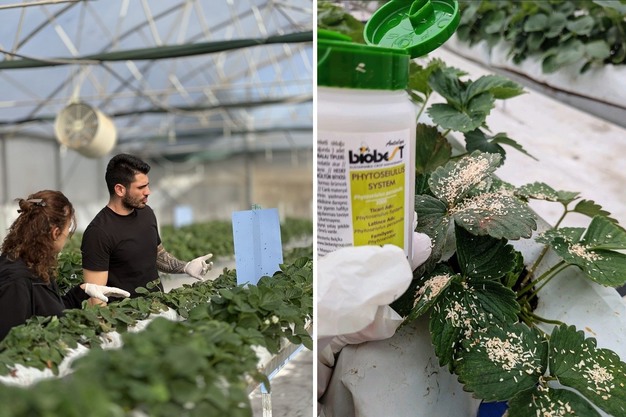
One of the most persistent challenges in greenhouse strawberry systems is the control of two-spotted spider mite (Tetranychus urticae). Claros Farm has conducted long-term trials evaluating the predatory mite Phytoseiulus persimilis as a biological control agent within soilless strawberry production.
"Our trials clearly demonstrate that chemical control is not the only solution. When applied correctly, Phytoseiulus persimilis can be highly effective as part of an integrated biological strategy."
Rather than relying on single interventions, Claros Farm employs multi-layered pest management approaches. Chemical pesticides are intentionally excluded to preserve beneficial populations and maintain system stability throughout the production cycle.
"Moving away from conventional chemical practices allowed us to evaluate the entire ecosystem inside the greenhouse," Birgül notes. "This shift resulted in more balanced and sustainable production outcomes."
 © Claros Farm
Preventive strategies beyond beneficial insects
While beneficial insects are a key component of pest management, Claros Farm's system extends beyond their use alone. Cost concerns often limit adoption of biological control among growers, a challenge acknowledged during early research phases.
"We questioned the economic feasibility of beneficial insects ourselves," she explains. "What became clear is that effective pest control depends on strengthening the entire production system, not just introducing predators."
Preventive strategies applied in the greenhouse include optimized plant nutrition, use of medicinal and aromatic plants, sulfur applications to greenhouse floors when necessary, and utilization of the repellent effects of essential oil aromas.
Among these factors, plant nutrition has proven to be the most critical. "Our research consistently shows that plants with higher leaf Brix values exhibit significantly stronger resistance to pests and diseases," she states. "Nutrition functions as a primary line of defense."
Biological control of pests and diseases
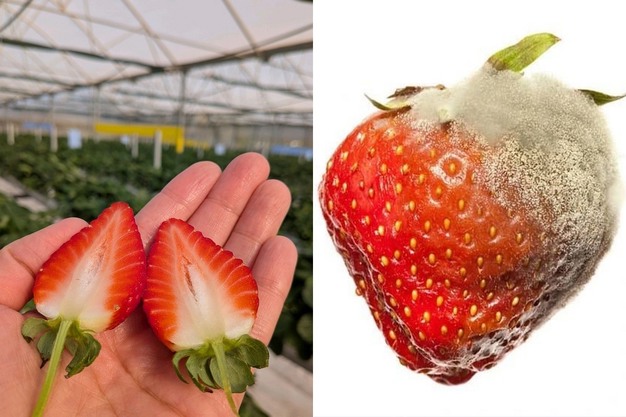
Using integrated biological practices, Claros Farm has successfully managed aphids, thrips, spider mites, and fungal diseases in greenhouse strawberries. The production system combines beneficial insects with selected beneficial bacterial formulations.
"In our bacterial trials, we observed improved root development and enhanced tolerance to stress conditions. These applications also demonstrated a suppressive effect on Botrytis cinerea, which is a major concern in strawberry production."
Medicinal and aromatic plants are positioned both around and within greenhouse structures to enhance repellent effects. Pheromone traps are also employed to intercept pest populations before they reach the crop canopy.
 © Claros Farm
Data-driven development and future research
All trials conducted at Claros Farm are systematically recorded and analyzed to ensure repeatability and transparency. According to Birgül, the broader goal is to transfer these validated methods to commercial growers.
"One of my main motivations is to make these field-tested approaches accessible to other growers. This is essential for advancing sustainable greenhouse systems on a wider scale."
In parallel with pest and disease management research, Claros Farm is conducting advanced studies aimed at increasing vitamin C levels in strawberries through biological and nutritional strategies.
"We have already achieved measurable progress. Our objective is to fully reach our targeted vitamin C levels in the upcoming production period."
For more information:
Claros Farm
Birgül Albayrak
[email protected]
www.clarosfarm.com