"Overall, cucumber prices were quite good in 2025. However, we had to deal with increased pest problems, which presented us with certain challenges in production. As a result, yields were below average in a multi-year comparison, while the tomato harvest was slightly higher. However, we now know how to deal with the pest problem and are well prepared for the next season. As a result, yields were below average compared to previous years, while the tomato harvest was slightly higher. However, we now know how to deal with the pest problem and are well prepared for the new season," summarizes vegetable farmer Christian Zeiler on request.
Improvement in consumer sentiment needed
In addition to his production sites in eastern Austria, Zeiler operates a cucumber farm in western Hungary, close to the Austrian border. The entire yield from this farm is exported to other European countries via selected marketing partners. From a horticultural perspective, the committed producer expects the cost structure to remain challenging in the coming year. "Costs, whether for energy, personnel, or taxes, are unlikely to fall in the coming year but rather to rise. At the same time, retail prices are trending downward to curb inflation. This is compounded by the production regulations we have to deal with in Austria, in contrast to those in southern countries. This competitive disadvantage is and remains a challenge."
On the sales side, Zeiler expects consumer sentiment to improve in the new year. "Q1 will most likely still be subdued, but hopefully purchasing power will pick up again towards spring. After around two years of crisis, I believe this is absolutely necessary."
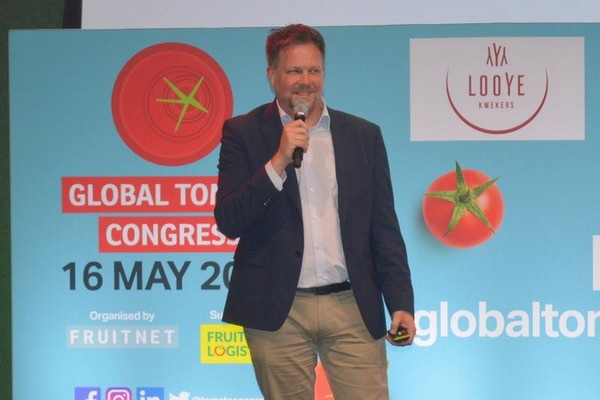 © Hugo Huijbers | FreshPlaza.com
Christian Zeiler on stage during the Tomato Congress 2023
Switch to HR varieties and cucumber production
Apart from the current marketing situation, Zeiler looks back on a few eventful years. "In 2021 and 2022, we had to contend with several ToBRFV infections on our farms. This contributed significantly to a complete restructuring of our company. Our Austrian tomato farms were completely converted to highly resistant varieties from renowned breeding companies. The Hungarian tomato farm, on the other hand, was converted into a highly automated cucumber farm. Here, approximately 8.5 hectares are now used exclusively for growing cucumbers for the export market. As a high-wire crop, cucumbers are quite similar to tomatoes, so this was the right step for us."
The search for the right tomato varieties is a lengthy process. "There were some varieties that we had been growing for years, but were forced to discontinue. In some cases, it was challenging to find a suitable, light-sensitive alternative that also met the requirements of the trade. In this respect, we had to press the reset button." Today, five varieties are growing and thriving at the various locations, primarily cherry tomatoes, flanked by vine tomatoes.
The future implementation of the EU Packaging Regulation (PPWR) on January 1, 2030, is also causing a stir in commercial horticulture. Zieler is rather critical of the practicality of the PPWR packaging law. "The tomato market thrives on impulse purchases: many consumers intuitively buy a punnet of tomatoes. The freshness and condition of the produce are crucial factors. This is about values such as transparency, product protection, hygiene, and shelf life. Combining all these things with the new packaging regulation will definitely be exciting and challenging. This raises the question of how sustainable it is if the new law ultimately leads to higher markdowns at the POS. Sustainability would have to be viewed as a holistic concept at this point. As a grower, I am fundamentally in favor of implementing sustainable packaging as long as the quality of the product being marketed does not suffer," he concludes.
For more information:
Christian Zeiler
Zeiler Gemüsevertrieb GmbH
Gärtnerweg 1
A-2482 Münchendorf
Tel.: +43-2259/870 72-0
[email protected]
www.tomaten.at