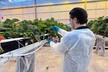
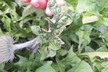
"If you want to understand why so many indoor farms fail, look at who is running them. Most of the time, there are no growers with genuine agricultural experience in the field; instead, individuals rely on borrowed knowledge from universities or tech companies. When growing strawberries, that doesn't work. Our approach is different; we combine decades of field expertise with a scalable seed-based system that eliminates viruses and makes global expansion possible," says Mr. Songtian Matsuda, CEO of MD Farm, a Japanese startup based in Niigata, developing fully automated strawberry farms.
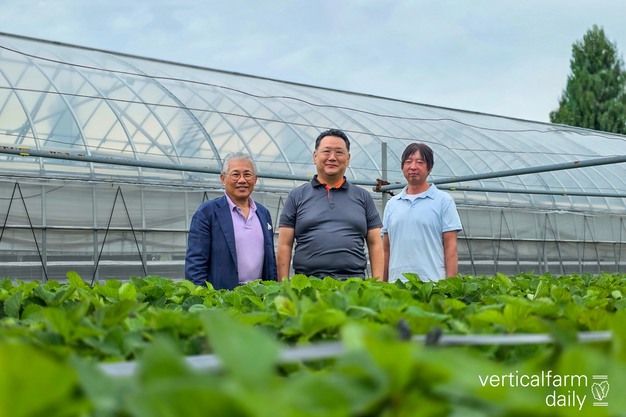 © Rebekka Boekhout | FreshPlaza.comMD Farm's co-founders: Matsuda, Hosoki, and Abe-san
MD-Farm was founded six years ago by five co-founders: Mr. Matsuda, Mr. Hosoki, Mr. Abe, and two others. With more than 13 years of hands-on growing experience, Niigata-based strawberry grower Abe is a solid rock and a craftsman for the firm. Niigata is home to the Echigo-hime variety, known for its sweetness but very fragile for long-distance logistics. Abe's berries typically sell for ¥3,000 per kilogram but are only distributed within a 10 km radius due to their fragility.
Throughout the years, the founders invested in automation to ensure autonomous strawberry growth. "We are not just strawberry growers. We provide a platform, seeds, robots, software, nutrients, and recipes that turn strawberries into a reliable product like a factory product. By combining Niigata's cultivation heritage with modern automation, we are building a model that can scale worldwide," Hosoki explains.
Japan's strawberry paradox
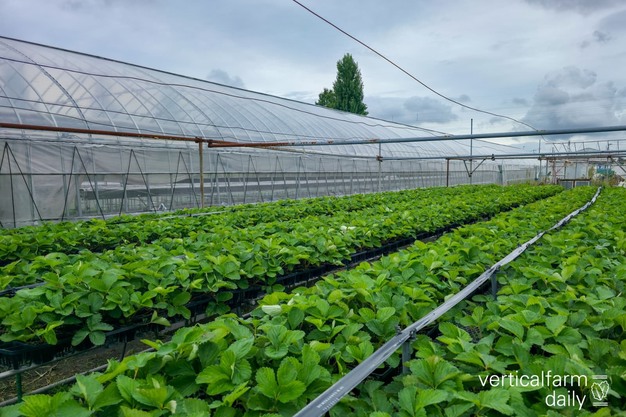
"Japan is one of the world's most competitive strawberry markets, yet it faces a structural problem. Most growers rely on June-bearing varieties, which means fruit is abundant from winter to spring but scarce in summer. Prices spike in December and January, reaching ¥3,000 to 4,000 per kilogram (€16,70-22,26), yet quality is inconsistent," Matsuda explains.
 © Rebekka Boekhout | FreshPlaza.com
Now, Hokkaido, traditionally a source of high-quality strawberries during the cooler months, has been affected by rising temperatures, driving market instability. For large-scale buyers, this is a significant challenge. Amongst them are cake manufacturers. "Strawberries, along with milk and eggs, are considered 'strategic goods' in Japan's cake and pastry industry. Around Christmas, demand peaks and bakeries demand large volumes of red fruit, like strawberries. Greenhouses can only provide a six-month supply, leaving gaps that disrupt production schedules and operations. This is where we can bridge a huge gap."
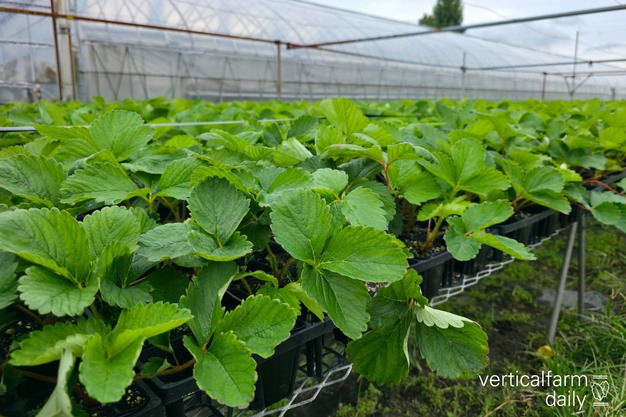
MD-Farm wants to build and operate next to the customers, who are cake manufacturers, in this current phase. When producing next to the client, quality loss due to transport is entirely out of the question. Field knowledge is critical. According to Matsuda, indoor farms often fail because they underestimate the importance of these basics. Tackling this hurdle, MD-Farm is translating Abe-san's knowledge, from 'how to manage Brix levels ' to how to time flowering, into digital recipes that can be replicated anywhere.
 © Rebekka Boekhout | FreshPlaza.com
Seed-based propagation as a foundation
Most Japanese companies propagate strawberries vegetatively. MD-Farm takes a different approach, growing directly from seed. This has its advantages: the seeds are virus-free, easier to export, and provide a clean start each cycle. The company sterilizes seeds in-house, improving germination rates from 60-70% initially to 95% today, with ambitions to reach 100%.
In contrast to many Japanese farmers, MD-Farm grows directly from seed, to have virus-free production, a clean start each cycle, and export convenience. Accordingly, clients lease seedlings rather than buy them to maintain a recurring revenue stream. Customers stay connected to the MD-Farm's Platform, where each plant is monitored for performance and comes with a 2-year guarantee. If yields drop, plants are replaced. "This protects our clients' output and stabilizes quality," says Matsuda. It also provides MD-Farm with a recurring revenue model, ensuring customers remain connected to the platform.
 © MD Farm
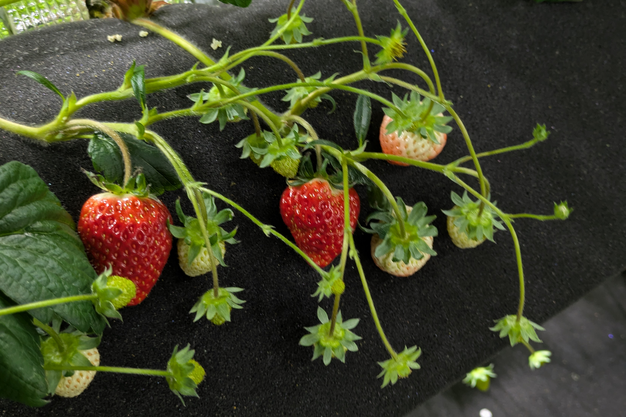
Strawberries cultivated in MD's farm
The smaller the farm, the greater the probability
What is the optimal farm size when cultivating strawberries indoors? Is it above 10,000 m²? "No. It's rather the opposite." To avoid megafarms, MD-Farm set up a so-called Standard Factory of 1,000 m², capable of producing 50-51 tons per year and containing 20,000 seedlings. Limiting the size of the production facility leaves more room for low-risk production and profitability, since it is easier to control the cultivation environment. Plus, it is easier to replicate. Living up to the promise, MD-Farm currently operates a 400 m² POC farm, alongside a production site featuring 700 seedlings that has been in operation for five years without any breaks. Both serve to validate the system, software, and automation before scaling up.
Every part of MD-Farm's system is automated and built in-house. Each rack holds 100 40 pots that move along the programmed route to pollination, irrigation, and harvesting stations. Robots, costing about $7,000 each, handle almost all labor, from moving shelves to high-frequency pollination. "We don't need bumblebees. It makes the system more adaptable across the globe," says Matsuda. The result of automation is that only two to three people are required to operate the farm. "We don't need traditional growers on-site. The system runs on recipes and turns strawberry production into a factory process," he adds.
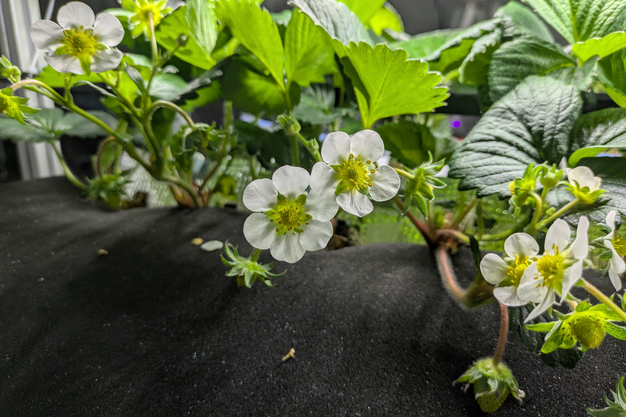
Irrigation stations are designed to avoid water recycling to reduce disease risk and can be cleaned easily due to their loose components. The LED lights cost half the price of industry-known brands, and "are more powerful. Because we design, develop, and control the hardware and software ourselves, we can adapt and improve faster, at lower cost." Additionally, the team designed a continuous-flowering system, patented in Japan, that enables steady yields. In combination with its farming software, the founders foresee a fruitful future.
 © MD FarmFlowering crops
Business model: focusing on cake manufacturers
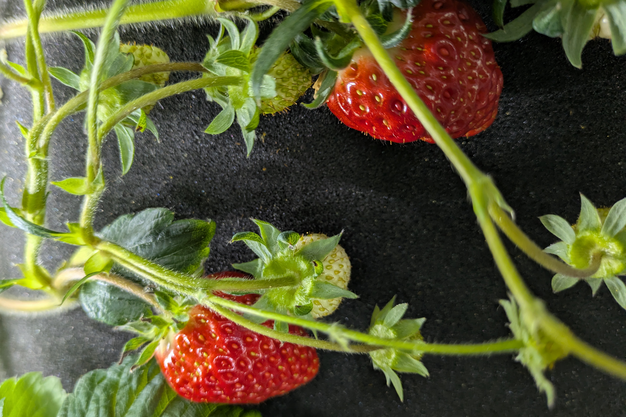
"Selling strawberries at ¥2,000/kg (€11,30) is not attractive for us. That's why we will focus on selling our operating systems instead to cake manufacturers and large food processing companies. These buyers value stability and consistency more than branding," Hosoki says. He explains that they can even save on more inputs, such as added sugars. Meeting a set level of BRIX, size, and firmness will help them to stick to their recipes with no adjustments required in the cream or sponge bases.
"We want to make strawberries an everyday fruit with the same flavor whenever it is tasted like a factory product, not a seasonal luxury. If Starbucks, for example, wants to launch strawberry-based drinks or cakes year-round, it requires a stable supply. Our system makes that possible, and it could create an additional business opportunity for them as well," says Matsuda.
 © MD Farm
Fundraising around the corner
Today, MD-Farm raised approximately $7 million in a government grant, which is structured as a five-year, interest-free grant. The funding financed the POC farm and the further development of the hardware, software, and growing recipes. Another fundraising round is planned for the end of this year, either in Japan or overseas, to fund the construction of the first 1,000 m² factory.
Once multiple farms are operational, the firm likes to supply both strawberries and seedlings whilst maintaining the quality and price throughout the entire supply chain.
In the future, Matsuda would like to export strawberry seeds and commercialize digital recipes using the MD-Farm Integrated Total Cultivation Solution System, available globally. Byproducts can be used for other purposes. This might sound ambitious, but today, MD-Farm is already testing the strawberry leaves for tea and pharmaceutical use. For international projects, the company prefers to collaborate with local partners that have the right market know-how.
Beyond strawberries, the same seed-sterilization and technology can be applied to other fruits and vegetables, since MD-Farm already holds the patents. "We'll see."
 © MD Farm
For more information:
MD Farm
[email protected]
www.md.farm (Japanese only)