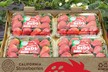
Over the past decade, fresh cranberries have become an integral part of the autumn product range in food retail. Nordgemüse, based in Buchholz/Aller, also offers domestic cranberries from an exclusive contract producer from mid-September to the end of October. "Depending on the weather and yield, we sell around 70 to 80 tons of domestic cranberries per year, with a slight upward trend," reports Christiaan Koellreuter, managing director of Nordgemüse Krogmann GmbH & Co KG.
Yields from domestic cultivation were satisfactory this year, although there were occasional increases in rejects due to quality issues. Koellreuter: "Two or three days of extreme heat in July were followed by increased rainfall. This had a negative impact on the cranberries, although there were fewer problems on the plots in the shade." Fresh cranberries are primarily considered an autumn product, used in sauces for game dishes and similar foods.
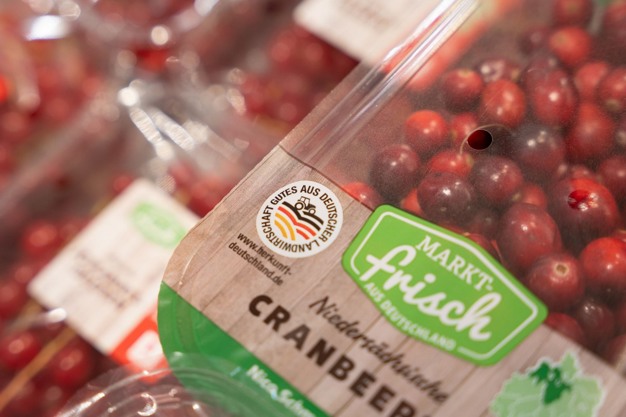 © Kaufland/Nordgemüse KrogmannDuring the German cranberry season, additional quantities are also sourced from Poland. Some food retail chains have listed the product until January.
Prices have been quite stable for several years, Koellreuter continues. Contrary to the trend, prices have actually fallen slightly rather than risen. "It is a very demanding crop that requires a lot of manual labor. In this respect, it is not exactly easy to make cultivation in Germany profitable."
Following the German season, food retailers are primarily offered overseas goods from the US. All in all, there has been a fairly smooth seasonal transition, says Koellreuter, looking back. "The lion's share of the North American harvest is sold to industry. This means that if there is a higher demand on the fresh market, we can usually respond at short notice. If there is too much produce available, we flexibly switch from the standard 200 g tray to large 400–500 g formats and run short-term promotions. In this respect, cranberries have established themselves as a solid product segment at the marketing level."
 © Kaufland/Nordgemüse Krogmann
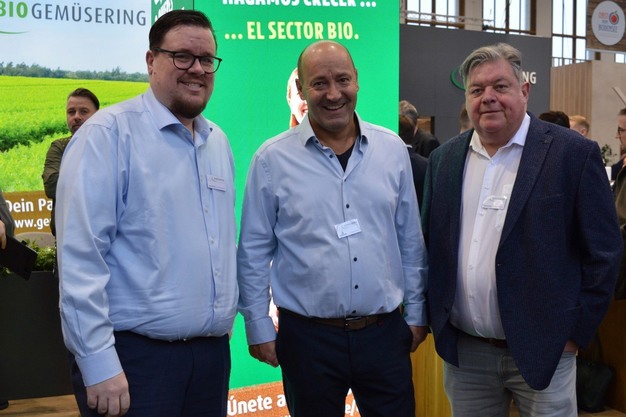
Christiaan Koellreuter (left) and Wilhelm Krogmann from Nordgemüse met their long-standing business partner, Hans Widmann (center) from the Bavarian company of the same name, at the last Fruit Logistica. Both companies are part of the Gemüsering.
Peruvian blueberry season in full swing
Parallel to the seasonal blueberry business, the overseas blueberry season is now also in full swing. "Peruvian produce is now available in abundance, and corresponding promotions are being run with large formats. Supply and demand are now almost in balance," outlines Koellreuter, referring to the revised volume forecasts. "Due to climatic conditions, 2023 was an extremely weak year for the Peruvian export industry, and the effects were still being felt in 2024. This year, initial forecasts pointed to an oversupply. Ultimately, however, a large amount of produce was exported to Asia and North America for price reasons, resulting in lower volumes for the European market, even though they are still significantly higher than in the previous two years." In addition to the origins mentioned, smaller quantities are currently being sourced from Namibia and Zimbabwe. In the organic sector, the focus is currently on produce from Argentina and South Africa.
The peak season in Peru is expected to continue until the end of November, while South Africa will also continue to play a major role until week 49-50. "Chile will start a little earlier this year, but will only come onto the market with larger quantities at the turn of the year. This means that there will again be a small gap between weeks 50 and 3 of the new year, but this is not unusual in our market segment," he concludes.
For more information:
Christiaan Koellreuter
Nordgemüse Krogmann GmbH & Co. KG.
An der Autobahn 50
29690 Buchholz/ Aller
Phone: +49 (0) 5071 96 80 00
[email protected]
www.nordgemuese.de