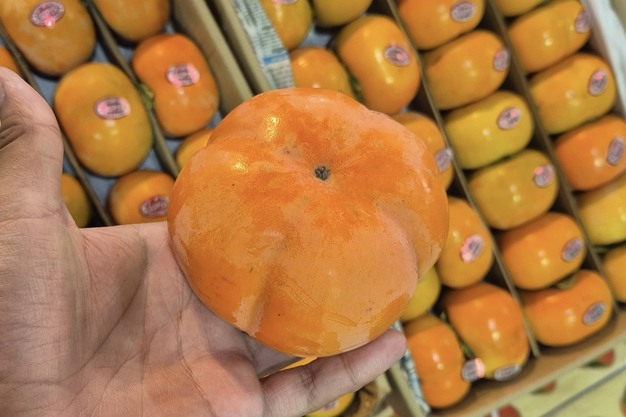
The Indian persimmon market, although still niche, has demonstrated steady production with growing domestic demand and cautious export ambitions, says Razi Qureshi of wholesaler and exporter Al Quresh Fresh. "The persimmon season in India runs from mid-October through December, with Fuyu and Jiro varieties grown for both local consumption and exports."
Qureshi explains that last year's attempts to export persimmons by air faced a setback due to a quality issue related to leaf rust, a problem not common in Spanish persimmons. "There's a difference in rust presence under the leaves between Indian and Spanish persimmons, which impacted our export quality and led us to pause shipments this year," he said.
 © Al Quresh Fresh
However, demand for Indian persimmons has been growing across metro cities, including Mumbai, Delhi, Bangalore, and Hyderabad. "Indian persimmons have a shelf life of about 15 days at ambient temperatures after harvest. While cold storage can theoretically extend shelf life by a month under carefully controlled low temperatures, such facilities are not widely available or used commercially in India. As a result, persimmons in the Indian market are mostly consumed fresh within two weeks of harvesting."
Qureshi highlights a key challenge faced by exporters. "While Indian persimmons are more cost-effective than imports from Spain and South Africa, export prices are inflated due to expensive air freight, limiting buyer interest abroad. Notably, strong demand has come from Gulf countries such as Saudi Arabia and Qatar, but packaging and quality issues have constrained shipments."
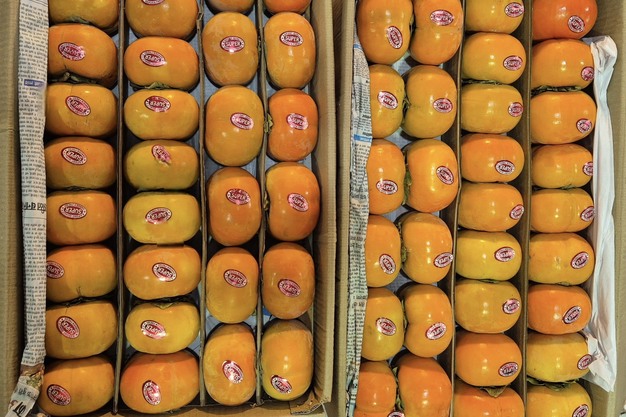
India continues to import a small quantity of persimmons mainly from Spain and South Africa during the off-season, but volumes remain limited, Qureshi shares. "Out of around 40 weekly import containers arriving in Mumbai, only one or two contain persimmons," Qureshi estimates.
 © Al Quresh Fresh
However, Qureshi mentions that persimmons are witnessing gradual growth as a niche fruit in India. "Farmers are noticing a rise in demand and have begun experimenting with new varieties and improved cultivation techniques, as further advancements in quality and handling are needed to expand export potential."
Currently, the price of persimmons is around USD 5.6 to 13.5 for a 7 kg box and USD 19 for a 14 kg box, depending on quality and counts. "We're seeing this price go up day by day and expect the price to touch USD 22.5 for a 7 kg box by the end of December, when availability is very low."
Qureshi concludes on an optimistic note: "India's persimmon market may be small at present, but there is hope of improving cultivation to compete internationally. Enhancements in quality control and logistics infrastructure can help access growing export opportunities, together with satisfying domestic consumption."
For more information:
Razi Qureshi
Al Quresh Fresh
Tel: +91 90 04 892 218
Email: [email protected]