Volumes, fair remuneration, and Drosophila suzukii: The association of producer organizations Cherries of France takes stock of the cherry campaign halfway through the 2025 season.
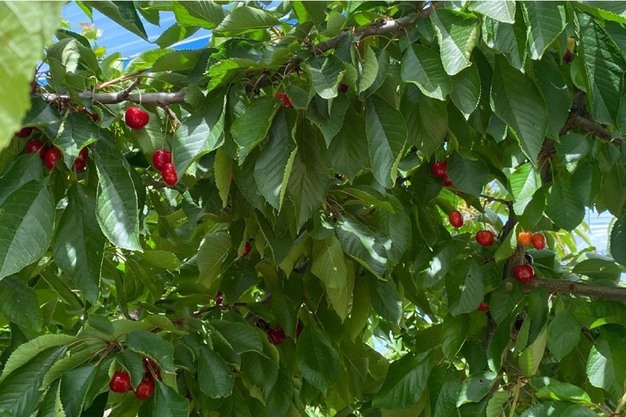 © AOP Cerises de France With almost 6,700 hectares under cultivation and over 30,000 tons produced each year (source: Agreste), France is Europe's 6th largest producer of table cherries / 2 kg of cherries: the average quantity bought by French consumers each year (Kantar).
"A clear improvement, but not yet back to historic highs"
"The 2025 cherry season has now entered its central phase, a week later than in 2024. Since mid-June, the harvest has reached its mid-point at the national level, and volumes are well up in all production basins. After several very poor years, the 2025 harvest is estimated at 80% of the potential of French orchards. This is a satisfactory level, which marks a clear improvement from previous years," according to the association, although we are not yet back to historic levels. According to the latest estimates published by Agreste (Ministry of Agriculture), French cherry production for 2025 is estimated at just over 33,000 tons, which is 5% more than in 2024, and 12% higher than the average between 2020 and 2024. "The current campaign is therefore part of a recovery cycle, after a marked dip in 2021. Continued favorable weather conditions towards the end of the harvest will be key to confirming this good level of production."
"The sector hopes to be able to offer French cherries until the end of July"
To date, the early basins (Pyrénées-Orientales, Gard) have completed their harvest. In the Ventoux, picking is in full swing: the Belgian variety, which is largely dominant, is currently being harvested, along with the Van and Satin varieties. Producers at higher altitudes (in Malaucène) will continue picking until the first days of July. In the Rhône valley (Drôme, Ardèche), production remains active, with at least two more weeks of harvesting expected. In Ardèche, supplies are increasing steadily, with the end of the season expected towards the end of July. In the Tarn-et-Garonne region, a gradual reduction in volumes is expected from the middle of this week. Finally, in the Monts du Lyonnais, the sector is now entering the peak of production, with the heart of the season concentrated between mid-June and mid-July.
For the time being, the campaign is benefiting from favorable weather conditions, with summer weather well established and conducive to consumption. This meteorological context is supporting a good sales dynamic, while all distribution channels are being supplied smoothly and regularly. "We are currently in the middle of the season, and the sector hopes to be able to offer French cherries until the end of July."
Renewing the generations, guaranteeing the future, and fair remuneration
This local dynamic is encouraging, but it is not enough to overcome the structural weaknesses of the sector on a national scale. Like other agricultural sectors, cherries are currently facing the challenge of generational renewal. Planting a cherry orchard requires a long-term approach. It takes an average of 4 to 5 years to obtain the first fruit, and an orchard has a lifespan of 25 to 30 years. A young grower starting today needs to think ahead to 2040. However, this ability to plan ahead is largely hampered by a lack of clarity on regulatory developments: Authorized products, environmental rules, taxation, start-up aid... The many unstable variables make projects more fragile. Ensuring a fair and steady income, securing outlets, and supporting start-ups: these are the keys to creating a new generation of producers and guaranteeing the future of the French cherry sector.
Phytosanitary products: Orchards in transition, a sector looking for sustainable alternatives
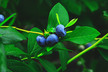
The main threat to cherry production in France today is Drosophila suzukii: A small fly originating from Asia that was officially identified in France in 2010. It has been causing a great deal of damage. With its formidable biological and behavioral characteristics - egg-laying in healthy fruit, short reproductive cycle, high adaptability - this fly has become a complex pest to control, capable of compromising an entire harvest. Highly polyphagous, it attacks not only cherries but also strawberries, raspberries, blueberries, and other small fruits. Its rapid development and uncontrollable spread have profoundly destabilized historic cherry-growing areas, making the future of some farms more uncertain.
 © AOP Cerises de France
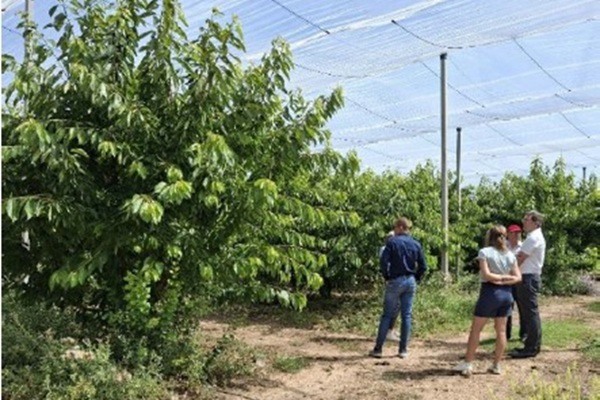
Cherry orchard under an anti-insect net / Created in 2009, the association of producer organizations Cherries of France brings together more than 800 cherry producers from four major regions: Provence-Alpes-Côte d'Azur, Auvergne-Rhône-Alpes, Occitanie, and Centre-Val de Loire. It currently has 16 economic structures: 10 fruit Producer Organisations (POs) - cooperatives and SICAs, 5 shippers, and 1 Interprofessional Association.
Faced with this threat, the sector has mobilized, with the support of public and private research, to find alternative control solutions. Pilot programs run by INRAE, CTIFL, and other technical institutes are underway, but the results are expected in the medium term. For the time being, growers are implementing practical solutions to protect their orchards, combining sensible phytosanitary practices, physical protection such as anti-insect netting, and field experiments such as mass trapping or parasitoids. Although still in the development and evaluation phase, these approaches are evidence of the sector's active commitment to making agriculture more resilient, more respectful of the environment, and better adapted to the challenges of the future.