When you ask Gert Smit, marketing director at Hendri Pieterse Boerdery in Groblersdal about their grape season which ended last week, he takes you back to the start of the grape harvest back in week 44, November last year. They had just come out of their citrus campaign during which logistics was a “hellish” challenge.
“There were a lot of discussions in the company and within this region before we started the grape season. We knew it was going to be challenging: we entered the season with the knowledge that sea freight was up by $1,100, that labour can go up by 16%, fertilizer and chemicals up by 10%, electricity up by 13%, diesel is up by 15%, and now Eskom [the state electricity supplier] is again talking about increases.”
South Africa’s early grape producers entered a good marketing window and grapes didn’t sell for low prices but, he notes, “when you subtract all of the costs we could definitely see the effect on the balance.”
Hendri Pieterse Boerdery, known by its acronym HNP, produces 1.1 million 4.5kg cartons of grapes and in two or three years’ time, it should be close to 1.5 million cartons of grapes. They also grow close to an annual million 15kg cartons of citrus, with much recent renewal pushing it to over 1.5 million cartons of citrus in the near future.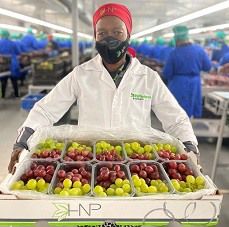 On grapes, their focus is very strongly retail, both locally and in Europe and the UK, but overreliance on a few markets carries a risk.
“In the Far East, and specifically China, we make certain that what we send is 100% what they want. It’s a cold steri market whose shipping protocols are not always favourable to fruit, so that limits our volumes there.”
Canada has a lot of potential, especially for South African citrus, but the transit time is long. This year they’d taken the decision not to send any grapes to Canada, given the early end to the US grape campaign and Peru’s record harvest.
High yield – 5,000 to 6,000 cartons per hectare – is non-negotiable for a farm to survive, and new varieties (like Autumn Crisp & Sweet Globe of which they took off their first commercial volumes this year, along with Sweet Celebration which made its debut on their farm last year) have, apart from their productivity, brought consumers back to the grape category and won back the shelf space over which, he remarks, there’d been a lot of hand-wringing a couple of years back.
“Sable is a niche grape working well for us, it’s one of only two black varieties we still have. Midnight Beauty is the other, with a focus on China, Vietnam and Malaysia on extra large berries, and large berries we’d run in EU & UK retail.”
All of the new varieties were planted with an eye on the markets in the East.
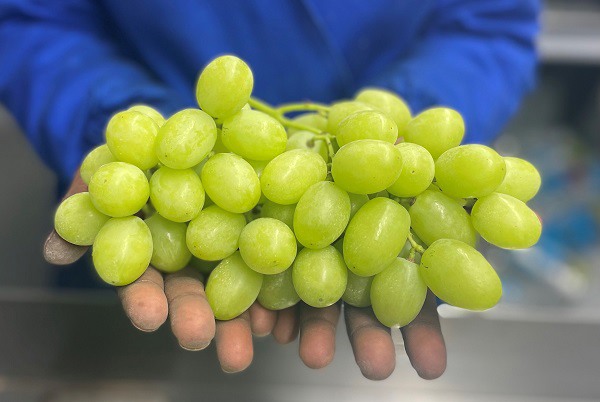 HNP's first commercial crop of Sweet Globe grapes was packed this year (photos supplied by HNP)
Impact of logistics: pre-Christmas grapes only arrived in week 2
“After the citrus season during which we battled to move citrus, we planned beforehand very thoroughly to ensure that we have containers and I think in Transvaal [the Northern Provinces] initially we were lucky, starting first in the country on grapes but since week 48 when the Orange River started, pressure has increased on shipping lines.”
Shipping schedules and equipment availability to the EU and the UK have to a degree been better but shipping to the Far East has been rough, he says.
They had grapes caught up in the power failure at the port of Cape Town late in December.
“We know our fruit has a limitation in terms of transit time so we’re always getting it away as quickly as possible. We’re 1,500km from Cape Town harbour. Our average turnaround time for a pallet is three days to be loaded onto a vessel. This year, however, some pallets waited 12 days before being loaded. It’s been a result of not getting containers, or space on a vessel, or there’s no vessel that week, plus unproductive harbours.”
He continues: “We are strongly driven by pre-Christmas arrivals: for instance, we packed fruit in wk48 and that fruit was supposed to arrive wk51 or 52, but only arrived in week 2.”
On the receivers’ end, there’s been a shortage of labour.
Pre-Covid there had been an increase in the number of naked packs they did for clients, grapes packed in 9kg bulk crates which move backwards and forwards between them and their clients, says Ursula Quinn, HNP compliance and quality assurance manager, but challenges regarding availability of the labour required to handle fruit has resulted in receivers requesting them to do a lot of the value-add (like packing mixed punnets) on the South African side.
Above average rain since the start of the grape harvest
“In the Northern Region we’re under heavy pressure in terms of harvesting grapes during the rainy season. Other grape farmers’ eyes widen when they hear we’ve had above average rain since we started the grape harvest in November. The rain has been exceptional this year: over the Christmas weekend we had 100mm and a few weeks ago we had another 100mm over one weekend. We adapt our spraying programmes, our irrigation, we have plastic over the grapes, but 100mm at a time is just too much and it does bring quality challenges,” Gert says.
The family business places much emphasis on compliance with audit requirements. “Compliance requirements are incredibly tough,” Ursula remarks. “I’d tell upcoming farmers who want to enter the industry that it’s going to be tough: it’s not only compliance, MRLs, quality, ticking all the boxes – audit after audit after audit.”
She adds that the company gets very high ratings on its audits, but there are always new versions for which they have to prepare. “We go out of our way to benchmark ourselves in the toughest markets.”
“Going forward, rising costs remain a concern,” Gert observes. “We have to adapt or we won’t survive and keep the ship sailing. We have to farm in a smart way with the right varieties delivering the right quality to the right retailers and buyers – that’s the golden key.” For more information:
Hendri Pieterse Boerdery
Tel: +27 82 387 3901
Email: [email protected]
https://www.hnpieterse.com/