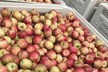
This year, the total top fruit production in the EU will be much smaller than in previous years. Especially apples have been affected by frost in the spring of 2017. In Poland, about 60 per cent of harvested top fruit will be quality fruit this year compared to the previous season, according to the Belgian Bart Liesenborghs, cultivation advisor in Poland. The fruit that is now being harvested is looking good. Bart has years of experience in this country and in recent years, he has noticed the share of industrial fruit declining, with Polish growers offering more and more quality fruit to the fresh market.
Growth
According to Bart, Poland ‘hasn’t done too badly.’
“The frost was later in Poland, so damages weren’t too bad compared to Belgium. Poland is an apple country, most companies only grow apples. For them, a large part of the harvest is just lost. The Netherlands and Belgium will always have pears to fall back on. Poland only produces a few pears, and the quality is nearly always disappointing.”
Sizing of the remaining fruit is large, “This year’s summer was fairly temperate and wet. Because of this, the fruits grew well, and they weren’t very affected by sunburn. Gala, Golden and Champion are the varieties that did best this year. The other varieties were more affected by frost, such as Jonagold, which just froze away.”
Better market
He indicates the smaller harvest has had a positive influence on pricing. “You can clearly notice that moods are better right now. This is also due to the fact that industrial prices are higher in Europe. That’s the base for pricing. When they have higher prices, the fresh market automatically also has higher prices. I expect good prices for apples this season.”
Cheap
If there hadn’t been any frost, the harvest would’ve ‘succeeded’ everywhere. “That would also have been a disaster. When everything goes well next season, we’ll have an enormous oversupply. Poland is the largest supplier and it’s difficult to regulate production. Poland’s strength is being able to produce cheaply. The Netherlands and Belgium can’t compete with their production prices. Polish producers have fewer alternatives besides apples. It’s difficult to grow pears in Poland, and especially with the current rootstocks people can’t switch to growing pears. The climate’s more fickle as well. We also have special weather circumstances, but the conditions are even more extreme in Poland. In Eastern European countries and Russia winters are becoming more and more extreme, so that production is becoming less and less constant. Yet volumes increase every year in Eastern Europe. One example of a growing apple supplier is Romania. Many apples have been planted around the Black Sea.”
There are many external factors, but the influence of the climate is enormous, according to the cultivation advisor. “First of all, climatological circumstances are difficult to assess, and besides, they can hardly be controlled or influenced. It’s truly something you have to learn to live with. Some producers think we can solve every problem, but some things can’t be controlled.”
Production
When it comes to production numbers, not much has changed in volume in recent years, according to Bart. “For decades, Poland has been the largest apple producing country, and they remained the largest when they joined Europe. However, a shift can be seen in the destination of the fruit. For example, Belgium is growing more and more for the fresh market, and less for industry. They have the know-how, and quality is produced, in large volumes.”
Future
In future, Bart expects that the Netherlands and Belgium will supply the local market increasingly often.
“It’s good to keep a larger percentage of local fruit on the local market. It will be a logical development as well, considering overseas suppliers from New Zealand and South Africa are choosing to increasingly supply Asian countries, where they’ll get better prices. In the Netherlands and Belgium they’re familiar with these varieties. We could choose to market our apples in China and India, but eating habits and flavour profiles aren’t going to change on those markets. We shouldn’t hope everyone will eat our apples just because we produced them. It takes much longer to introduce a product, and to convince people it tastes good. Tree-nurserymen from New Zealand develop specific varieties for the Asian market, they produce what customers want.”