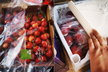
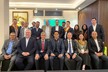
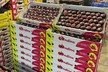
The Italian partners of the Pink Lady® Europe association are Apofruit, Mazzoni, Salvi, OP Minguzzi, Vog and Granfrutta Zani. General Director Thierry Mellenotte chose to inaugurate this event with orchard tours and analyses on segment perspectives and also took part in the day organised at Salvi-Unacoa in Ferrara. Two hundred people attended including producers, schools (100 5th formers from Istituto Vergani-Navarra in Ferrara), suppliers and journalists.
Left to right: Mauro Grossi (AFE President), Thierry Mellenotte (APLE General Director), Luigi Salvi (founder), Marco Salvi (Salvi Unacoa President), Silvia Salvi (Salvi Vivai President).
Not just a simple club apple
Pink Lady® Europe is an association that is not just a simple varietal "club". It is in fact a board organisation where all actors (nurseries, producers and authorised producers) are involved in its governance. This enabled the creation of a true synergy thanks to which all partners can share experiences, skills and techniques. Thierry Mellenotte explained that "the main purpose is to protect and promote European production extending the supply calendar (until July or August) to guarantee interesting profits to producers and maintain the promises made to consumers."
Thierry Mellenotte and Marco Salvi
Pink Lady® apples are very popular in northern Europe, with a brand awareness around 80-85% (in Italy, the percentage is around 40-45%). "Often, however, consumers ignore that the produce they are purchasing is grown in their own country. This first Pink Lady® Day is just one of the activities we plan to organise to display our environmental sustainability and social responsibility."
The same concept was stressed by Afe President Mauro Grossi (together with Salvi Unacoa, it manages the processing of Pink Lady® in its Ferrara facility). "Sustainability means giving companies the chance to run a profit and keep producing. Apple cultivation was being abandoned but, thanks to Pink Lady®, we guaranteed profit and innovation. We're not just talking about a commercial brand, but about a nursery, producer and distributor organisation. The strength of this project is its capability of involving producers and the entire chain as a whole. The Pink Lady® chain is placing great effort in raising awareness as regards its environmental, social, economic and ethical sustainability. All elements that are decisive when consumers make a choice."
Mauro Grossi
The Pink Lady® project was the first of its kind - it put together production and commercialisation and even acquired a bargaining power towards the retail sector unimaginable in other segments. An internal commission made up of three producer members takes part in the management of all steps within the chain.
In love with pink apples
One of the three commission members is Riccardo Volpin, owner of a company in Settepolesini di Bondeno (FE). Of Venetian origin and with a past in Venezuela, he is the perfect example of what Pink Lady® represented for producers.
Greetings between Volpin and Mellenotte
"It was love at first sight when Vivai Salvi brought us to see it in French orchards twenty years ago. We learned the most suitable cultivation technique (Solax) which was rather difficult at first, but I can now say that high quality pays off. We worked on merit-based criteria, passing from 45% of category I apples to 75%. Colour percentage is what makes a Pink Lady®. Producing apples with a pale or bright colour costs the same, but the profit is entirely different!"
Visit to the orchard
Apple harvesting at Volpin (30 hectares out of 100 are dedicated to apples) started 8-10 days early thanks to the ideal weather conditions during late March/early April (blossoming period).
Harvesting operations involve multiple phases: three in the lower part of the plants and two in the top part. All orchards are protected by anti-hail nets. To obtain large grades, Volpin thins trees three times during the season. The planting pattern is 3.80x1.30 metres and there are two separate irrigation systems (drip and over-tree). Soil is rather heavy, but it seems trees adapt well to it and actually develop improved organoleptic characteristics (Brix between 14 and 15°).
Marco Salvi, Sonia Volpin with her father Riccardo, Thierry Mellenotte and Silvia Salvi with the first Pink Lady® apples of the 2017/18 season
All apples are collected at the Salvi Unacoa facility. Salvi recently increased its refrigerated storage capacity.
Tour of the facility
According to operational director for collection and post-harvest processing Stefano Zampini, apples are collected in a specific unloading area where experts perform a first quality check according to external visual parameters as well as internal texture, sugar level and starch parameters.
Stefano Zampini
Traceability starts here, from processing and distribution, until proceeds are paid to producers.
Ms. Valentina from quality check
Storage and water grading follows before batches are shipped to destination markets.
Expectations for the 2017/18 season and beyond
Thierry Mellenotte explains that the European Pink Lady® season will officially start on 2nd November, while supplies from the southern hemisphere are ending (New Zealand, Chile and Argentina).
"Despite the bad year for apples, Europe should have the usual quantity of Pink Lady® apples, estimated at 180 thousand tons. 75% of the volume is exported. We aim at reaching 280 thousand tons in 2025 with an annual growth between 6 and 10%. We want to do so while maintaining the percentages of the various production areas and helping young entrepreneurs who want to accept the challenge. France and Italy currently represent 45% of the European production each, and Spain produces the rest. Exported produce reaches 50 different countries."
Mellenotte stresses that, in addition to traditional northern European countries (Germany, UK and Scandinavia), South-East Asian markets such as Singapore, Thailand or Malaysia are already very important. The hope for the future is for the Russian ban to be lifted and there are studies assessing the perspectives of the Chinese market, which though appears to be very complex.
Multiple varieties can be cultivated under the Pink Lady® brand: not only the famous Cripps Pink (named after its Australian creator John Cripps, who crossed a Golden Delicious with a Lady Williams), but also Rosy Glow and Sexy. The important thing is that they meet certain qualitative criteria: currently only 65-70% of produced apples meets the requirements, while the rest is sent to the processing industry. Marco Salvi explains that "Pink Lady® apples are particularly popular with the processing industry as they are uniform, therefore making cutting operations easier. There is not much waste and a juice line is also being created."
The first Pink Lady® Day was therefore an occasion to introduce a new corporate communication strategy that envisages a higher partner involvement and awareness.
Thierry Mellenotte and Mauro Grossi
Thierry Mellenotte concludes: "Demand is very strong in Europe and everybody would like to produce more, but it's not simple as the agronomic characteristics are not easy to manage: apples blossom early but are harvested late. They require a lot of experience and skill. Controlled development is required for them to comply with all the characteristics required by the brand and the market. These apples acquire added value when sold with the Pink Lady® sticker and packaging."
"Despite all this, our project is the first of its kind that gathers potentially competing countries such as Italy, France and Spain. In addition, it is also the first that requires producers to invest in technique, communication and marketing. It's like a family of enthusiast workers who want to work together to improve. And it's being directly responsible for your business that makes the real difference."
Below: greetings at the end of the day