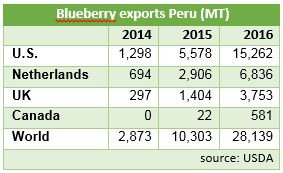
A rapid growth in production is expected for the coming year. Cultivation is concentrated in La Libertad, a coastal region in the northern part of Peru. The volume exported grew from 10,303 tonnes in 2015 to 28,139 tonnes in 2016. This is expected to increase to about 40,000 tonnes this year.
Lucrative despite heavy investment
Five years ago, there was no significant blueberry cultivation in Peru. At present 4,000 hectares are being used. In the near future, this area is sure to increase. Despite the high costs involved in this type of farming - about $6, 000 per hectare - it is an attractive option for farmers in this country. Profit margins are high and in La Libertad, where most of the farms can be found, harvesting can take place almost year round. This is thanks to the mild, warm, dry climate.
 Plantations are modernly equipped with irrigation systems. There is almost no disease. Most of the plants are exported to the USA. They have a preference for the Biloxi, Emerald and Springhigh varieties. The berries are harvested by hand and packed directly for export. One hectare produces, on average, 15 to 20 tonnes of blueberries. According to some, Peru will develop into the biggest blueberry exporter in South America in the years to come.
 No domestic market
Blueberries are not popular among the locals in Peru. Although blueberries are good for your health the high prices scare off customers. Almost all the blueberries harvested in Peru are destined for the export market. A growth in its export of 43% is predicted for this year. The country has developed a reputation for consistently good quality. Last year, 54% of the berries were exported to the USA. The Netherlands is in second place with 24%, followed by the United Kingdom (13%) and Canada (2%).
The increase in the volumes exported, up 171% in 2016, compared to the previous year, are continuing, despite prices dropping. In 2015 a kilo of blueberries still fetched $11.00; last year this dropped to $7.00. This meant a total export of $242 million for Peru, an increase of 150%.