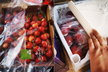
The bagging of Vinalopo table grapes has started this week in a campaign in which around 11,000 people are expected to work for about two months, according to data released by the agrarian union Asaja.
The bagging will be carried out in the more than 2,200 hectares registered under the Regulatory Council of the Designation of Origin, where 80 million bags are expected to be used to cover the clusters that meet the quality and selection criteria.
Growers predict that the 2017 season will be characterised by the fruit's excellent quality and calibres; a result of the rainfall recorded this winter, although there will be a slight drop in the production volume, mainly in the case of the Ideal and Aledo varieties.
The bagging process will protect the grapes and allow them to ripen until they are ready to be harvested and consumed during the autumn and winter, especially at Christmas.
This agricultural technique is unique in the world and will continue to be carried out until next month in the plantations of Monforte del Cid, Aspe, Novelda, La Romana, Agost, Hondón de las Nieves and Hondón de los Frailes.
With the beginning of the bagging of Vinalopo table grapes also come the first harvest forecasts for the 2017 campaign in the territory covered by the PDO.
It should be noted that the production of the varieties Dominga, Doña María, Red Globe, Rosetti and Victoria is expected to remain stable, while a slight decrease, of between 20 and 25%, will likely be recorded in the case of the Ideal, with the prospect of reaching six and a half million kilos, and a drop of about 10% is expected for the Aledo variety, with almost 23 million kilos.
In total, the estimated production this year of all varieties registered in the PDO will reach 44,578,375 kilos.
This campaign, producers also predict the production of fruit with excellent organoleptic qualities and good calibres, since the setting has gone well so far thanks to the intense rains recorded last winter, which cleaned the roots of salinity.
The president of ASAJA Novelda, Pedro Rubira, announced that, "in general, the amount of clusters is smaller, but they are bigger and it is clear that there has been an excellent setting, so the quality of the grapes should be excellent."
Once again, the Vinalopo table grape campaign is marked by an increase in production costs for the grower, which has seen them rise by 75 percent, while the price paid for a kilo of grapes remains the same as 20 years ago.
Another issue that has raised the concerns of producers, and which could contribute to the decline of the harvest, is not just the drought, but the quality of the water in most of the areas where the plantations are irrigated.
"We do not have good quality water to irrigate our plantations because the one we get is a mixture of sewage treatment plant and drought wells, and although there are products available to treat and improve it, this entails an additional production cost that we cannot afford," he denounced.
Source: EFE