Together with the coordination technical group, Agrion technicians made an assessment on cherry cultivation in Piedmont. They analysed the varieties and grafts chosen, layouts, protection nets, segment economy as well as the defences against its main adversities.
As was to be expected, the fact that the Psa led to the uprooting of over 1,300 hectares caused significant changes in Piedmont's production. Many opted to grow apples (at least 900 ha), while others chose more innovative products such as Actinidia arguta (baby kiwis), table grapes and cherries.
The interest in cherries is such that orchards already cover 280 hectares in Piedmont. In the post-kiwi phase, some companies invested one or more hectares aiming at intensive cultivation. However, wrong choices could lead to unsuccessful investments.
For this reason, Agrion's team, which includes over 30 technicians, decided to analyse in depth all aspects concerning cherry trees and examined some of the largest orchards in the area.
As regards varietal choices, the harvesting calendar starts a few days earlier than Burlat (early June) and ends approximately 40 days later. The species' main problem is that it is rather sensitive to cracking in case of rain near harvesting time. Most of early-ripening varieties have a similar problem, so we recommend growing them only under plastic films. In Piedmont, weather conditions in late May/early June are often difficult so producers must consider what to do.
When planning new orchards, technicians recommend carefully choosing the percentage and varieties to use as pollinators.
For this reason, Agrion's team, which includes over 30 technicians, decided to analyse in depth all aspects concerning cherry trees and examined some of the largest orchards in the area.
As regards varietal choices, the harvesting calendar starts a few days earlier than Burlat (early June) and ends approximately 40 days later. The species' main problem is that it is rather sensitive to cracking in case of rain near harvesting time. Most of early-ripening varieties have a similar problem, so we recommend growing them only under plastic films. In Piedmont, weather conditions in late May/early June are often difficult so producers must consider what to do.
When planning new orchards, technicians recommend carefully choosing the percentage and varieties to use as pollinators.
The cultivars of reference that showed good adaptability in open fields and the most recent currently being tested are: Early Star® Panaro 2, Folfer, Giorgia, Mariant Giant Red, Grace Star, Kordia Attika®, Ferrovia, Regina, Fertard.
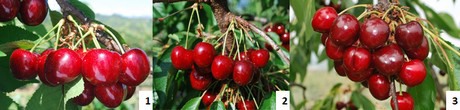
Cherry cultivars: 1) Folfer, 2) Grace Star, 3) Fertard.
When planning cherry orchards, plant vigour is the most important feature to consider. The soil and intrinsic vigour of the different cultivars must be taken into consideration to avoid disappointing performances with insufficient renewal and unsuitable grades.
New orchard management techniques that include specific thinning methods and high-density layouts are becoming more and more popular, especially since growth-retardant products are forbidden (paclobutrazol). The real reliability of these techniques is still being assessed, as it depends on the type of soil and cultivar.
The rootstocks that proved adaptable to the Piedmont area are: Gisela® 5, Gisela® 6, MaxMa Delbard® 14, Colt.
Those wishing to plant a cherry orchard should also consider installing anti-rain and/or anti-insect nets. Actually, anti-rain nets are practically compulsory in case of varieties particularly sensitive to cracking. A few mm of rain close to harvesting are enough to compromise most of the produce. The supporting system must be designed with relative side tie-rods.
Less sensitive varieties like Kordia and Regina don't need anti-rain nets, so the cost of cultivating them is lower.
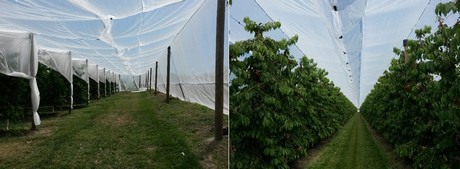
Anti-insect net
Anti-insect nets are increasingly becoming a necessity in Piedmont. Drosophila suzukii and the brown marmorated stink bug are colonising our territories and traditional methods (i.e. chemical treatments) do not guarantee satisfactory results. Cherries are mostly affected by Drosophila and, to counter it, fine mesh nets are needed (1.4 x 1.7 mm) however they tend to be more expensive.
Due to insect size and the number of generations, orchards must always be fully covered.
Production costs hover between €1.80 and €2.00/kg depending on productivity/ha, yields and initial investment with or without nets. Consider that harvesting labour impacts on 50% of the price. Production per hectare go between 70 q/ha to 130 w/ha, while harvesting yields over around 10-12kg/hour/man.
If protection nets are installed, the initial investment can reach up to €80,000-90,000/ha, so it will take longer to break even.
Contacts:
Graziano Vittone e Lorenzo Berra
Agrion - Fondazione per la ricerca, l'innovazione e lo sviluppo tecnologico dell'agricoltura piemontese
Tel.: (+39) 0171 388880
Web:www.agrion.it