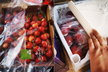
Tim Altham, General Manager.
One grower however, remained almost unaffected by the difficult growing conditions. "Personally our crop estimates were accurate, only Pink Lady was not quite what we were expecting," explains Tim Altham, General Manager at Pickmee. "This may be a problem as Europe is shouting out for them. So we are having to decide where to send the fruit."
Other varieties such as Royal Gala, Braeburn and Fuji are good, as are the premium lines like Smitten and Kiku.

There 20 size drops in the packhouse in Waikato.
Pickmee is one of the few apple growers in Waikato and the only apple packer. Most of the others are located further south in Hawkes Bay, the main part of Pickmee's production is also there.
The orchards in Waikato were planted by Tim's grandfather, which he said was probably just circumstantial as there were not many other apple orchards around at that time. Tim's father is now the sole owner of the company and Tim has grown up in business, his first job was mowing the grass in the orchards.

40-50 people work in this packhouse.
"Hawks Bay has the right climate for growing apples its dryer and cooler at night so you generally get a better product," according to Tim. "Waikato is generally a bit too wet, but we have worked out how to grow apples here. We are a bit more susceptible to tree diseases here but if you run it well with good staff and good managers it can be done. We get good colour and good flavour, its not a bad place to grow."
Pickmee grow about 12,000 bins in Waikato and a further 30-40,000 bins in Hawkes Bay.

It is a fully manual packhouse, much of this could be done with cameras.
New innovative packhouse
The company is building a new facility in Hawkes Bay, the business down there is growing and is already about three times the size of the Waikto. The new facility will change the way apples are packed in New Zealand.
"Due the volumes we grow in Hawkes Bay we have decided to build our own facility there. The packhouse will be able to handle 70,000 bins so we have room for growth. We reckon that in five years we will up to around 50-55,000 bins there."

6.5 tonnes per hours can be sorted here.
"With this new facility we will be moving away from the model of how apples are packed in New Zealand. We are going for the European model and buying Dutch equipment from Greefa, no one else has ever really used anything else but New Zealand machines before. We are going for a 100% pre-size model where all the fruit is pre-sized and graded before it gets to a carton."
Tim spent three years researching which equipment to use, listening to feedback about the systems available. "Its all about the gentle handling, technology and cameras, this what is important when you are replacing people and we felt that Greefa’s handling and technology was more advanced than the others."

The sampling quality control, with a complete in and out record of the fruit.
The New Zealand way of packing is to commit every apple into cartons then find a customer for it, Pickmee will now sort the fruit and store it in bins and pack to order.
"The supply chain of packed containerized shipping to customers has reduced to months or even weeks; people pack some sizes with no idea about what they are going to do with them. These cartons sit in storage for 2 months before being shipped for 8 weeks and then stored for another week at the other side before going to the retailer."

Class II apples will go to wholesalers and grocers.
"It takes a lot more room to store cartons than bins, and the time to customer from time of packing ie. the last inspection, is much reduced so you can guarantee that quality. The biggest benefit from a company point of view is the number of staff needed to manage this," said Tim. "Here it takes 50 people to move 6.5 tonnes per hour, in the new facility four people will presort 12-14 tonnes per hour, and 5 people will pack 5 tonnes per hour into cartons for orders, this is a huge saving as labour is our biggest cost."
The Hawke's Bay facility will be completed by late Jan 2018, ready for next season's harvest.

This packhouse was built in 1972 and it difficult to automate an old building.
Increasing exports
The New Zealand pipfruit industry has set a target of achieving $1 billion in exports by 2022 and is well on the way toward achieving that.
Is that realistic? According to Tim, the problem is what is happening in the Northern Hemisphere. Italy, France and Germany are producing more Pink Lady, North America is able to store their apples for longer and more and more people are looking to Asia.

There is an automatic pallet strapper.
"We are finding that these days Asia is our best market in term of returns, but we feel the pressure as the US are shipping for longer."
He does not see South Africa, which gained access to China for apples recently, as a threat, "At the moment they can't really grow an apple for China, they don't get the size or the colour, but they are putting fruit into Thailand and Malaysia and Indonesia and that does affect us because they produce much cheaper than us."

The pallets are scanned.
Old or new varieties?
It is well know that varieties for Asia have to be sweet, large and red and a lot of Pickmee's new varieties are driven around that.
"We have planted a lot of Dazzle which is destined for the Asian markets, New Zealand Queen is an old variety which we have learned to grow better. In the 90's people were having trouble with russet on the skin but now we have learned how to control this.

Prepacked apples for Countdown.
"We are also doing some European varieties. We are tied in with an Italian company growing some of their varieties, such as Issac, a small snacking apple, high in acid. It is a hard apple and doesn't bruise easily so its good for snacks on the go. We are promoting it as a sports apple.
"Our biggest global variety is Royal Gala, no matter what country or customer you go to they all want the Royal Gala. We have planted more of that and this is a variety which is 40 years old.

"We are being asked for Granny Smiths in Asia - who would have thought that? Thailand are asking for it and so is China. We don't have the protocol to send Grannies to China yet, so unfortunately we can't supply them.
"USA is also a big market for Granny Smiths and we also sent some into Holland last year. While others are pulling out of Granny Smith we are actually planting them. Braeburn is not much in demand, it has kind of run its course, there other varieties which have replaced it, such as Smitten.

Granny Smiths are sorted.
But despite the popularity of the old varieties there are people who will insist on having a favourite club variety regardless of the price.
"What we try do is grow what people want, but you also have to grow what people think they need, this is the difficult thing. We have the new Piqa Boo® pear and next season we should a have saleable crop. The marketing on this is not to sell a pear but sell a story. People think a pear is a pear, so how do you convince people to pay the premium price for this one? You need to sell the story as well having a great quality pear to back it up. The Piqa Boo® will go to Asia, but we will also try it on the New Zealand market too.

This is where the boxes are made.
Domestic Market
Unlike kiwifruit, where the domestic market gets the Class II fruit, special programs are grown for the domestic apple market. The difference in supplying the local market is the time frame from picking to shelf, which is 3-5 days. With exports it can be on the water for up to 8 weeks. The quality is not necessarily lower but the standard does not have to be just quite so high, for example in terms of pressure, because the fruit doesn't have to last as long. It only needs two weeks of shelf life instead of eight.

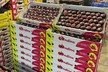
Pink Ladys ready to go!

A full truck ready to head out.