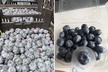
The Spanish region of Extremadura will return to the top of the ranking of the largest cherry producers this year, after Aragon snatched it from them in 2016. The prospect this campaign is to reach 35 million kilos, compared to the approximately 25 million kilos of Aragon.
The latest production prospects of the Ministry of Agriculture and Fisheries, Food and Environment (Mapama) set the total Spanish cherry production at 90.22 million kilos, 4.1% more than in 2016. Of that amount, 30.20 million kilos (+20.3%) correspond to Extremadura and 25.65 million (+0.9%) to Aragon.
The impact of rainfall reduced Extremadura's harvest in 2016 to 20 million kilos, far from the 33.87 million of 2015, according to the estimates of Cooperativas Agroalimentarias de Extremadura at the end of last season.
Now, sources from this organization have pointed out that the members of the Jerte Valley Cooperative Association will harvest 20 million kilos this year; a figure "above the average of a normal campaign, which is 16 million," and estimate a total production volume for the region of 35 million kilos.
These good results have been possible thanks to the accumulation of cold hours, which allowed for an ideal and uniform fruit setting and very good calibres in the first batches marketed.
Downhill in Aragon
In Aragon, UAGA-COAG fruit manager Vicente López reported that this year's yields per hectare have fallen, and although the cherry acreage has been expanded with another 1,300 hectares, the volume will only grow by three million kilos and stay a little above 25 million.
López pointed out that Aragon is still the main producer of cherries for fresh marketing, since part of Extremadura's fruit is intended for the processing industry. He also confirmed that 60% of the production has already been harvested. The season kicked off in the area of Caspe on 20 April and will end on 20 August in Calatayud.
The fruit manager of UAGA-COAG is encouraging unemployed Spanish seasonal workers to go there to pick cherries, as they are short of staff. As a reference, he explained that the gross salary stipulated for this work is 50 Euro for eight hours; about 1,200 Euro per month.
In Alicante, another of the cherry producing areas whose marketing season has overlapped this year with that of the Jerte Valley and Aragon, the production forecast is two million kilos, similar to that of 2016. According to the president of the Designation of Origin Cerezas de la Montaña de Alicante, Hilario Calabuig, although the total production volume in the province is the same as last year's, that of certified cherries will drop from one million to between 500,000 and 600,000 kilos.
"The rains recorded in late April took a toll on the quality of the cherries and a considerable part of the production could not be certified," explained Calabuig, who also highlighted the increase in exports, mainly to Italy, France and the United Kingdom, as well as the good prices recorded in the first week: 18 Euro per kilo.
Alicante's cherry season, which started early this year, on 20 April, (compared to 29 April last year) will come to an end in mid- or late June on the farms that are 900 metres above the sea level.
Calabuig estimates that the province has already harvested about 40% of the production and that now, with the mid-season cherry, the prices at origin are, on average, one Euro higher than those of the previous season, since they range between four and five Euro per kilo.
Prices
In Mercasa's network of wholesale markets, the highest average prices for the fruit are usually reached in the first days of May. On 2 May 2017, it stood at 7.76 Euro/kg, compared to the 8.75 Euro/kg of 3 May 2016 or the 7.67 Euro/kg of 5 May 2015. Since 2010, the highest average wholesale price for fresh cherries was that of 2 May 2014, when it reached 10.42 Euro/kg.
Source: eldiario.es