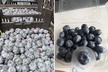
After a record-breaking cherry harvest in 2016, Zaragoza's new campaign is underway with a drop in the early cherry volumes and a greater stonefruit production than expected.
"We have had some problems with the setting in the earliest cherry varieties, so we will harvest around 30% less than last season, although with a very high quality," states Sergio Alonso, from the commercial department of the agricultural cooperative Cosanse, of Almunia de Doña Godina.
"So far, we have only sold 15% of our cherries this season and we are satisfied with the prices. But from now on, the mid-season varieties will become productive, so we will have more volumes and we will see then how the market develops, although it seems that we could fill some gaps in the export market, given the impact of frost suffered by producers in countries like Poland, Serbia or Hungary.
The cherry acreage in Almunia de Doña Godina has been expanding gradually in recent years, with a continuous varietal conversion. Cosanse allocates more than half of its production to exports, where large calibres are more appreciated, according to Sergio Alonso.
"We export mainly to European countries, as they are currently absorbing our supply, so we are not forced to seek distant destinations like Hong Kong or other Asian countries, where after some tests, we are not satisfied with the results."
According to Sergio Alonso, current trends in the marketing of cherries favour the use of smaller containers which, although expensive to produce, meet the current needs of large distributors.
"Just 10 years ago, we were selling many 5 kilo boxes, and 8 years ago we started to sell more 2 kilo boxes, which we pack manually, in the traditional manner, aiming to meet the requirements of the customer. We now offer 1 kilo containers, both standard and premium category, with a better design and added value. We are also offering 1 kilo and 500 gram baskets and 700 and 250 gram cups, which are intended for quality cherries and which some supermarkets are selling in premium lines."
A difficult summer expected for stonefruit
While last year there was a shortage of nectarines, this year we expect a normal season in terms of production, with more volumes also in the case of peaches and a more notable growth in the apricot production, which has resulted in an increase in the thinning costs.
Spain has started harvesting and shipping stonefruit for export almost two weeks earlier than usual, with greater volumes than last year and with unfavourable weather conditions at destination, which together with the pressure from supermarkets, has led to prices collapsing. "Given the current situation in the market, with prices already at such low levels, we expect a difficult summer. Hopefully, when we start with larger volumes, prices will at least remain stable and stop falling," points out Sergio Alonso.
For more information:
Sergio Alonso Zaragoza
Sociedad Cooperativa Agraria San Sebastián
T: +34 976600050
[email protected]
www.cosanse.com