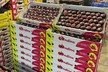
The development of new strawberry varieties, as has been the case also with other red fruits, has been marked by the revolution observed in Huelva in recent years. Following the predominance of varieties imported from famous American universities, such as California or Florida, producers have gradually been looking for alternative formulas to avoid paying high royalties and gain access to local materials, better adapted to the province's growing conditions.
Thus, according to data for the current agricultural campaign, processed by the Institute of Agricultural Research and Training (Ifapa) of the Council of Agriculture, Fisheries and Rural Development of the Regional Government of Andalusia, despite the fact that the variety Fortuna (University of Florida) continues to lead the ranking of the most planted varieties in Huelva, with 33.75% of the total, the sum of Huelva's three main local varieties (Primoris, Rábida and Rociera) already accounts for 37.25% of the market share.
Of Huelva's three varieties, the Primoris accounts for about 90 million plants, which is 16.28% of the total acreage devoted to strawberries; the second is the Rábida, with 55 million plants and 9.99% of the total acreage, while the Rociera, which is still in its first commercial year, already accounts for 55 million plants in Huelva, which is 10.05% of the total acreage. The latter case is particularly striking, considering that only 1 million plants were planted as a test in the previous campaign, and with a prospect to reach between 80 and 90 million plants next year.
Consequently, the breeder of the three local varieties, the Huelva-based company Fresas Nuevos Materiales S.A. (made up of Caja Rural, 16 nursery companies in Castile-Leon and most of the fruit's producers in the province) currently controls 37.25% of the market share, the highest percentage when compared to other breeders operating in Huelva. Next in this ranking are the University of Florida, which controls 33.76% of the market share with its Fortuna variety; Plant Sciences (12.73%), the University of California (8.49%), Planasa (3.81%), Freshforward (2.01%), Driscoll's (1.32%); Nova Siri (0.51%) and CIV (0.12%).
Source: Huelva Información