The French like blueberries less than the British. Soft fruit outside the season has less flavour. Germans mainly eat the soft fruit at breakfast. The first statement is true. The second is what many consumers think. The third is false. This was shown in research conducted by Ipsos Mori. Pippa Bailey presented the results during the Global Berry Congress and gave an insight into the British, French and German markets.
In both the United Kingdom, France and Germany the strawberry is the undoubted favourite. Over a third of those asked in the three countries said they had bought strawberries in the previous twelve months. Raspberries and blackberries also score well in the three countries, with around 25% and around 20% of those asked buying these fruits. The results for blueberries were more varied. The British and Germans both scored above 20%, but France remained at 14%. This means considerably fewer French consumers buy blueberries.
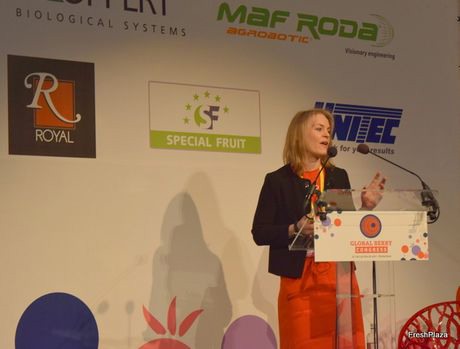
Pippa Bailey, Ipsos Mori.
Generation gap in consumption
Looking more closely at participants, something else stands out. In general the youth are underrepresented. This goes for all kinds of soft fruit, although blueberries are the exception. "In the age bracket 15-34 we see a peak, this is often because those in this group have a family and the blueberries are suitable for families," says Pippa.
To appeal to the younger consumer, Pippa sees opportunities for frozen fruit, for instance. The price of soft fruit could be a barrier for this group. OctoFrost, a Swedish company that supplies IQF cooling machine, also sees opportunities for the sector here. Later in the day Anna Dyc placed the spotlight on this machine. Freezing fruit is also a way to reduce waste. Anna Dyc estimates that 20% is lost during cultivation of soft fruit, and another 3% is lost during post harvest treatments. This is all before the product is on its way to the customer. "Freezing requires special equipment to really extend shelf life," according to Anna.
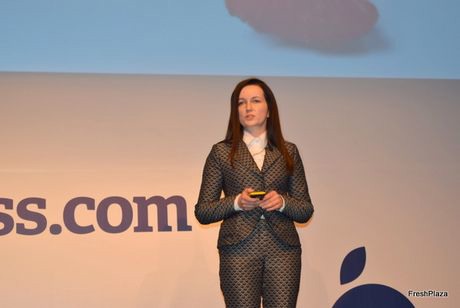
Anna Dyc, OftoFrost.
Consumption moment depends on country
There are big differences in the moment when the soft fruit is consumed between the three countries. The British consumer eats considerably more soft fruit, especially blueberries and strawberries, at breakfast. This fruit has also built up a position as a snack, the strawberry does particularly well in those moments.
The French on the other hand choose croissants and baguettes over soft fruit. Only a small percentage of the fruit is eaten during breakfast. The whole snacking culture is less developed in France than in other countries, says Pippa. Not surprising that the soft fruit is hardly consumed as a snack. As a dessert the soft fruit has a strong position. This is when a lot of the fruit is consumed. German consumers stand out when it comes to snacking on soft fruit. Strawberries in particular are a popular snack. "The total fruit consumption in Germany is higher," says Pippa. There is also more evenness in the consumption of the fruit.
Shelf life less important
There are however, two points on which the German, French and British all agree. In all three countries flavour is by far the most important when buying soft fruit. Second most important is that the consumers want value for their money. There are, however, clear differences on other points. Where the German consumer believes the appearance of the fruit is important, the French and British attach less value to this.
Shelf life less important
There are however, two points on which the German, French and British all agree. In all three countries flavour is by far the most important when buying soft fruit. Second most important is that the consumers want value for their money. There are, however, clear differences on other points. Where the German consumer believes the appearance of the fruit is important, the French and British attach less value to this.
There are big differences in organic. The British believe this factor is least important when buying. In France there is clearly more value attached to this. Where the French and German clearly attach value to local consumption, this is less important in the United Kingdom. Compared to the two other countries the shelf life is less important for a German consumer. "Germans consume the fruit faster than in the United Kingdom or France so shelf life is less important."
Consumers also have a lot of prejudices or wrong ideas. 79% of the French believed that soft fruit doesn't taste as good outside of the season, despite all the efforts to market tasty varieties. This percentage is also high in Germany at 64%, and 42% of those in the United Kingdom agreed with this statement as well.
The same goes for the share of imported fruit in the supply. This was overestimated for strawberries in all three countries. For raspberries the opposite was true. The French believe that 49% of raspberries are imported, when it is actually 75%. In Germany the consumers overestimated the share of imported fruit.
The same goes for the share of imported fruit in the supply. This was overestimated for strawberries in all three countries. For raspberries the opposite was true. The French believe that 49% of raspberries are imported, when it is actually 75%. In Germany the consumers overestimated the share of imported fruit.