This article will discuss some of the current FO trials underway in South Australia and Western Australia and outline some of the initial results produced to date and where these trials might be heading in the future.
Young tree growth project
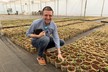
Joel Brockhoff manages the family orchard ‘Otherwood’ which is the South Australia Focus Orchard. The orchard contains 15 hectares of apples and a mixture of avocados, citrus and kiwifruit. One of the trials on Joel’s orchard is to investigate different tree growth treatments to optimise the growth and particularly the height of newly planted trees.
On a newly planted block of Aztec Fuji, six different strategies were used, all with the aim of optimising the growth and particularly height of a newly planted block. Three of the treatments involve pruning trees back to a whip (removing all side branches) with no heading cuts at planting. The other three treatments involved whipping the trees as well as heading (cutting the tree tops back by about 30-50cm) at planting.
The trial has just completed its second growing season and is showing some interesting trends:
- The better treatments in the first year were not automatically the best at the end of year two.
- The treatments which were meeting the objectives of the project the best, did appear to be whipped (but not headed at planting) and then whipped again at the end of the first growing season. They also provided the best extension growth in the leaders.
Around the world there is shift in horticulture, reducing the number of trees planted per hectare by growing more stems per tree. The current trial on the Fontanini focus orchard in South West, Western Australia aims to demonstrate the possibility of improved production using the simplicity of simple, narrow, accessible and productive (SNAP) tree management on a mature Cordon planting system (multiple stems grown on a single trunk).
A few rows of old Cordon style trees on the Western Australian Focus Orchard have been used to try out new SNAP tree training system. By using older Rosy Glow and Fuji trees and re-working them to fit the notion of the SNAP system, growers can learn valuable skills sooner than waiting for a newly planted block to come into production. Lessons learnt here can be transferred to newer plantings in the future.
Over the next few years’ trees will be managed using some simple SNAP pruning rules. The driving influence behind the shift to SNAP systems is the ability to increase yields of better quality fruit by re-vitalising existing older plantings. Valuable lessons will be learnt in this orchard demonstration with results expected in June 2017.
Leaf defoliation in low chilling environments
One of the issues in Western Australia, is delayed leaf drop in the autumn and the impact that has on the duration of dormancy. Many growers in Western Australia defoliate apple tree leaves in differing ways. The question always asked is; “Does leaf defoliation enable the trees to enter the dormant phase earlier and therefore gain more winter chill in a low chill environment?”
When a sample of orchardists were surveyed about their orchard practices around leaf defoliation some interesting information was collected:
- 70 per cent of Western Australia growers defoliated apple tree leaves.
- 30 per cent did not defoliate the leaves.
- 42 per cent were applying nitrogen to boost bud quality;
- 33 per cent felt their trees were entering the dormant phase earlier and therefore gaining more chill;
- 17 per cent undertook the management practice to clean up the orchard as disease prevention; and
- 8 per cent used the opportunity to start pruning earlier.
To further test the surveyed data and the hypothesis, four defoliation treatments were tested across Cripps Pink, Kanzi and Buckeye Gala. Treatments included the described grower standard of Urea or Zinc, a control as well as ProTone (ABA Abscisic Acid) and a Dormex treatment.
Ongoing weekly monitoring has already produced some interesting observations between treatments and between varieties. After the first monitoring round, trees treated with ProTone still had some leaves (30 per cent) to drop compared to Urea which had fully defoliated on the Buckeye Gala and Cripps Pink, with around 10 per cent of leaves remaining on the Kanzi treatment.
Further assessments will be undertaken to see if flowering was positively impacted by defoliating the leaves. It is hoped that these results will be available at an upcoming Future Orchard Walk.
source: apal.org.au