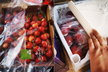
The period most at risk will be April, when produce from Basilicata and Spain will become available, as well as the first greenhouse productions from northern Italy.
Bad weather in January caused delays in production
Over the past few days, Gianluca Baruzzi and Paolo Sbrighi from CREA in Forlì went on a mission to the Scanzano Jonico area in Basilicata to assess the new genetic material obtained as part of the CREA research project, co-financed by "Piraccini Secondo srl". The objective of the breeding project is to identify new genetic material suitable for the Basilicata region.
Melissa and Pircinque varieties
The Pircinque and Jonica varieties have already been introduced. Pircinque was also patented in Brazil, where producers seem to be very interested.
"The cold temperatures in January led to losses of 50-100 grams and even blocked the development of plants in some areas. I have estimated a 20-30 day delay with respect to last year. This of course can lead to overlaps with other production areas and a dangerous produce concentration in April. Producers already had to spend a lot of time eliminating deformed fruit caused by frost, so the season did not start as well as it could. Let's hope it improves," explains Baruzzi.
PIR79.6 selection
The researchers visited numerous orchards. "Among the new varieties, Melissa ripens between Florida Fortuna and Sabrosa. It has an excellent appearance with regular-shaped fruits, even though cold years such as this one accentuate achene defects."
Demand is high, but produce is lacking due to the problems mentioned above.
Researchers also analysed the new material currently being studied which will probably be introduced soon.
"A few varieties are undergoing final testing. In particular, we saw the good results of PIR 79.6 and PIR 75.8, which have good-quality fruits with a good shelf-life. The former is performing well in Huelva too."
Contacts:
Unità di ricerca per la frutticoltura (CREA-FRF)
Via La Canapona 1
47122 Forlì
Tel.: +39 0543 89428
Email: [email protected]
Researchers also analysed the new material currently being studied which will probably be introduced soon.
"A few varieties are undergoing final testing. In particular, we saw the good results of PIR 79.6 and PIR 75.8, which have good-quality fruits with a good shelf-life. The former is performing well in Huelva too."
Contacts:
Unità di ricerca per la frutticoltura (CREA-FRF)
Via La Canapona 1
47122 Forlì
Tel.: +39 0543 89428
Email: [email protected]