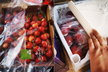
The cold snap that has recently hit the province of Huelva has caused a reduction in the strawberry production which, at least for now, is up to 60% lower than that of the previous season at this point in the month, as reported by Freshuelva. Despite this, producers are being offered lower prices, with those recorded in 2016 as reference.
This is one of the main concerns for Huelva's strawberry sector, and which was discussed at a meeting of the Strawberry Board held last week. The Government of Andalusia, represented by the Councillor of Agriculture, Carmen Ortiz, the president of the provincial government, Ignacio Caraballo, and entrepreneurs and cooperatives, took part in a debate about some of the circumstances that are now marking the role of Huelva's production in the market.
One of them is the low production recorded at the start of the campaign. The manager of Freshuelva, Rafael Domínguez, estimated the reduction at 60% compared to a year ago. "The previous season started earlier. In January, we were saying it felt like February, and we were harvesting every day. This winter has been a real winter, with plenty of frost," explained Dominguez. "Thus, this year's strawberry marketing has nothing to do with that of the previous year. "
This has been revealed mostly to allow "large distributors to be informed, so they they are aware that not every year is the same, that you cannot organise strawberry promotions when there are no strawberries; when demand and supply are balanced."
This, however, is not the sector's only concern. There is also the fact that there are countries where, "quietly and without making too much noise, the acreage devoted to strawberries and other fruits is growing every year." In the Netherlands and France, according to Rafael Domínguez, the greenhouse acreage is on the rise, with a "technological revolution at all levels encouraged by the Administration, by the way;" one that applies heat and light to accelerate the productive process and accelerate the fruit's entry into the market. This is also the case in Germany, "although fortunately, this year has been so cold that the increase in costs involved in the necessary heating may have made it uninteresting to speed up the production."
Aside from the growing production in the rest of Europe, Interfresa president José Luis García-Palacios has pointed to distributors as the main rival in the market. "It is absolutely essential to keep the communication with distributors as fluid as possible to defend the payment of good prices and the maintenance of reasonable quotas throughout the campaign," he explained.
García-Palacios, however, spoke optimistically of the current campaign and highlighted the "remarkable unity observed this year in the sector, such as we had never seen before."
The Councillor of Agriculture, Carmen Ortiz, also did not overlook the good situation of Huelva's strawberry sector when analysing its future. She mentioned the "high level" of producers who are making progress in marketing and innovation. In the field of modernisation, the Agricultural Research and Training Institute of Andalusia (Ifapa) has "made a very important bet on diversification."
Ortiz highlighted the increase in last year's strawberry exports, which were up by about 20% compared to the previous season. Proof, he said, of Huelva's great contribution to Andalusia's leadership in the horticultural sector.
Source: huelvainformacion.es