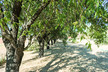
The province of Malaga has started a new chestnut campaign with the harvest of the early varieties: the Portuguese in Igualeja and Cartajima, the early Bravía in Jubrique and the Galician in Juzcar and other municipalities. Currently, the harvest of these early varieties, which actually represent only a very small percentage of the total production, has already been completed. "The fruit has good quality and good colour, but the production is small. Depending on the area, there are ups and downs in the volume harvested, but unfortunately the current one is a bad year," stated sources of the business association, Asaja Malaga.
The organization said that in September, the parts of the Genal Valley that recorded the most rainfall had up to just five litres per square metre; this, together with the "high temperatures" registered in August and September, "have not helped in the optimal development of the fruit."
Asaja Malaga recalled that the harvest of the main variety in the Genal Valley, the Pilonga, is expected to start soon, depending on the area. "The harvest forecasts are bad and the process will be very laborious. It has been very sunny and the cupules are dry. The trees have many empty cupules and also some with very few chestnuts. Chestnut growers keep looking at the sky, waiting for lower temperatures and rain, at least so that the tree, cupules and soil cool down, thus facilitating the harvest," he said. Although it is still early to make a forecast, all these factors point to a "bad year," according to Asaja. In a normal year, the 3,500 hectares of chestnut trees in Malaga produce between 3.5 and 4 million kilos of chestnuts.
Regarding the early varieties, Asaja explained that the harvest has been poor in Jubrique due to the heat of the last two weeks. "The cupules are very dry; in many cases, they do not fall and they must be forced down," he said. Igualeja and Pujerra have also harvested a smaller volume than expected.
Asaja also mentioned the chestnut gall wasp, a pest that "is driving growers crazy." Last spring, the release of its natural predator, the Torymus, was organised a few times in order to control the pest; "All agreed it was too little too late. The Ministry has not yet authorised the marketing of the predator so that producers can protect their chestnut trees. This delay in containing the pest can potentially entail a significant decline of the chestnut production in years to come, as has been the case in Italy," they affirm.
Source: laopiniondemalaga.es