Scientists hope China's red bayberry can be commercial success in Australia
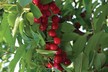
Professor Daryl Joyce, from UQ's School of Agriculture and Food Sciences, says it is a bit like a mulberry. "But it's actually not like any other fruit because it's a completely different species and genus to anything else in horticulture at the moment that we eat," he said. "It's got a seed inside it like a cherry seed, it's got a flesh around it like a berry flesh and it's about the size of a lychee."
UQ scientists have already spent 15 years developing the red bayberry in Australia. Industry backing recently enabled researchers to enlist the help of growers who are overseeing test orchards up and down the east coast of Australia.
Dr Melinda Perkins, a research officer at UQ Gatton, says most of the trial plantings have only been in the ground for about two years. "They are only just starting to produce fruit," she said. We really need to find out what varieties perform best where, and get as many trees in the ground as soon as possible for an industry to take off in Australia.
Growers have provided scientists with feedback, and sent fruit samples for laboratory testing. Scientists then analysed the size, colour and sweetness of the fruit to determine under which conditions red bayberry trees produce the best yield.
Dr Perkins says the challenge for researchers is to successfully propagate the red bayberry tree fast enough for the venture to be considered commercially viable.
"We really need to find out what varieties perform best where, and get as many trees in the ground as soon as possible for an industry to take off in Australia," Dr Perkins said.
Source: radioaustralia.net.au