Canada: Eastern growers plant new pear
The new production is taking place in Canada—the two provinces of Ontario and Nova Scotia—where the variety Harovin Sundown is being grown by a half-dozen growers and marketed as a club variety.
The club members are following the advice of New York’s Dr. Terence Robinson, the Cornell University horticulturist. He says growers should be able to use the same high-density system they use for tall spindle apples—close spacing, simple trellises, renewal pruning—even without having dwarfing rootstocks.
And, in Canada, that’s what they’re doing.
The trees are being produced exclusively in the Mori Essex Nursery and can be planted only by members of the Vineland Growers Cooperative in Ontario or those subcontracted through the Scotian Gold Cooperative in Coldbrook, Nova Scotia.
Growers
One of the growers is John Thwaites, who in the last four years has grown from “no pears at all” to about 34 acres of Harovin Sundown punctuated with some Bosc and Harrow Crisp as pollinizers.
Asked what role fire blight resistance played in his decision, he answered, “that was it.” He had never grown pears before—his 400-acre farm near Niagara-on-the-Lake comprised peaches, vinifera grapes, and 100 acres of asparagus.
Vineland Research and Innovation Centre owns rights to the pear, which was bred there by Agriculture and Agri-Food Canada scientists. The cross was made in 1972 by Harvey Quamme, and the variety was released by David Hunter in 2009.
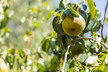
“It’s a nice pear,” Thwaites said. “It looks like a Bartlett—just a little bigger and bit stockier. A few shoots will develop fire blight—you see a few on twigs or branches—but it does not spread. The tree is able to stop it.”
The rootstock on which it’s being grown—Old Home by Farmingdale 97—is also resistant to fire blight, as well as being productive and precocious.
John Fedorkow, a neighbor of Thwaites, four years ago planted three more acres of Sundown in a high-density system using single axis trees in a 3- by 12-foot planting, but he’s got a lot more experience with the variety. He planted trees already in 1997 when it was an experimental variety being tested by growers.
“I have never sprayed Sundown to control fire blight—never,” he said.
In his test plantings one year, he lost all the Bartletts and not one Sundown or Harrow Crisp.
He was selling the pear long before it was being promoted as a unique variety. Since Vineland Growers entered the picture, “a whole marketing program has been built on the Sundown pear, not linking it in any way to Bartlett,” he said. And that’s the right way, he said. “It has a flavor all its own that is unique and pleasant. It tastes good.”
His goal is 20 to 25 tons per acre. Since the trees are on a vigorous rootstock, the three-wire trellis “is just to keep the tree growing straight in the first few years,” he said.
Lisa Jenereaux, the orchard manager at her family’s Spurr Brothers orchard in Melvern Square, Nova Scotia, said growing pears “is all fairly new to everyone who is trying it. There used to be pears here 20 years ago, but there were huge fire blight issues, and we got tired of fighting it.”
Back then, pears were grown for processing. “We’re looking at it quite differently now,” she said.
Marketing rollout for Sundown coming in 2015
A Canada-wide marketing campaign for the Harovin Sundown pear will start in 2015, when volume has grown enough to justify a big rollout.
That’s according to Michael Ecker, president of Vineland Growers Cooperative, whose members and subcontracted growers combined will have about 100 acres bearing the fruit. More are being planted.
The Vineland Growers Cooperative has exclusive rights to grow and market the pear in all of Canada. The owner of the pear, the Vineland Research and Innovation Centre, is looking for growers in the western United States.
While no concrete plan for marketing the pear has been developed, Ecker said they have put aside some money for a fairly aggressive marketing campaign, which will be a big launch, by Canadian standards. Canada has about 33 million people, a tenth the population of the United States.
The pear ripens in October and stores well, Ecker said, so marketing will go on from December through February.
Source: goodfruit.com