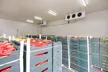
Ukraine's fruit and vegetable sector is not being held back by production capacity, but by a shortage of modern storage. The gap is estimated at around 340,000 tonnes, and its impact is visible across the market: post-harvest losses, forced sales at low seasonal prices, unstable supply, and weaker export readiness.
Industry estimates suggest vegetable losses can reach 30–35%, largely because many farms still lack proper storage or rely on outdated systems. As a result, producers are often forced to sell immediately after harvest, when supply peaks and margins are at their lowest. In practice, this turns a potentially manageable product into a short-window commodity.
The issue has become more acute in recent years. According to market assessments, the storage deficit in Ukraine's vegetable sector has grown from 40% in 2021 to 60% in 2025. This is no longer just a farm-level technical limitation; it is an economic constraint affecting growers, traders, retailers, and exporters alike.
WINHUB is positioning its answer to this challenge through a network of next-generation logistics parks and integrated vegetable storage facilities. The company plans to develop 1 million sq m of Class A logistics parks along key Ukraine-EU transport corridors, including Kyiv, Odesa, Lviv, and Dnipro. The model combines storage with the services the market increasingly requires: temperature and humidity control, sorting, post-harvest handling, packing, and shipment preparation.
For the fresh produce sector, this matters because modern vegetable storage is not simply about keeping product longer. It is a pricing and supply management tool. Producers with access to high-quality storage can delay sales, preserve marketable quality, and enter the market when prices and demand are more favourable.
One of WINHUB's flagship projects, Odesa Industrial Park, is designed as a large-scale logistics and industrial hub with around 150,000 sq m of Class A warehousing, supported by office, R&D, and service infrastructure. Within this model, WINHUB is also developing a network of vegetable stores with a capacity of 15,000 tonnes each in Odesa and other regions.
If rolled out at scale, this kind of infrastructure could reduce losses, stabilise supply, improve standardisation, and strengthen Ukraine's position in the European fresh produce trade.
Source: www.seeds.org.ua