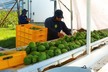
Passion fruit is shifting from a crop for poverty alleviation to a strategic product in Vietnam. The U.S. Department of Agriculture has finalised technical procedures to open its market to fresh Vietnamese passion fruit, with 2026 expected to mark the start of exports.
By early 2025, the national cultivation area was estimated at 12,500 to 15,000 hectares, mainly in Gia Lai and Dak Lak in the Central Highlands and Son La in the north. Average yields are 35 to 45 tons per hectare, with high-tech production reaching up to 70 tons per hectare. Revenue per hectare ranges from VND250 million to VND350 million (US$9,800 to US$13,700), with net returns three to four times higher than traditional industrial crops.
Vietnam ranks among the top ten passion fruit exporters, competing with Brazil, Colombia, Ecuador, and Peru, and is active in concentrated juice production.
Market access remains a priority. On 25 March 2026, Deputy Minister Hoang Trung met a USDA delegation led by Luke J. Lindberg. The U.S. confirmed the completion of the technical evaluation for fresh passion fruit. Vietnam requested accelerated approval of irradiation facilities and vapour heat treatment. The USDA indicated that procedures would be completed in time for the 2026 harvest.
Growers in production regions report expectations of improved market access. K'Sor Phuoc, a farmer in Dak Doa Commune, said: "Hearing that passion fruit is about to enter the U.S. market, we're all thrilled. Previously, we worried about unstable outlets, but now with businesses guaranteeing purchases and expanding markets, we have even more motivation to farm cleanly."
Luong Thi Mai, a farmer in Son La Province, said passion fruit has provided stable income and supported household expenses. "I hope our local passion fruit will soon appear on U.S. supermarket shelves," she said.
Maintaining access to the U.S. market requires compliance with planting area codes and pesticide residue limits. Industry participants highlight coordination between state authorities, research institutions, businesses, and growers to support export development and supply chain integration.
Source: Nhan Dan