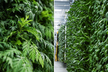
Swedish vertical farm Supernormal Greens - Ljusgarda has moved decisively beyond leafy greens. Following its recently announced pivot away from lettuce toward plant-based ingredients, co-founder Erik Lundgren says that more than ten medicinal plant species have already transitioned from research into large-scale production inside the company's controlled-environment facility.
"We have taken R&D projects with sample groups of around 10 to 100 plants, and now transitioned them to batches of 14,000 plants per batch in our industrial set-up," he explains. "It's not commercially continuous delivery yet. It's the step that proves the plants are feasible and can meet targets at large scale, not only in R&D." © Supernormal Greens - Ljusgarda
From ethnobotany to production scale
For Lundgren, the work begins long before seeds enter a growth chamber. His process starts with ethnobotany. "It starts with ancient texts. Old pharmacopeias. Handwritten remedies. Oral traditions," he says. "Why were these two plants always combined? Why fermentation instead of drying? Why water here, alcohol there, vinegar somewhere else?"
From there, the second layer is modern science. Peer-reviewed research, metabolic pathways, compound synergies, bioavailability, and enzyme interactions. That understanding now feeds directly into Ljusgarda's production strategy. Instead of optimizing for fresh biomass, the company is optimizing for compound density.
"Three species are currently on their way to harvest. Ocimum sanctum, also known as Tulsi, is an adaptogenic powerhouse with strong antioxidant and anti-inflammatory activity. Plantago lanceolata, or ribwort, is rich in iridoid glycosides and phenolics, with applications in soothing and microbiome-supportive formulations. And Borago officinalis, or borage, a source of gamma-linolenic acid, supporting skin barrier function and inflammation balance."
In addition to these, Lundgren notes that the company has also worked with Eclipta prostrata, Artemisia annua, Melissa officinalis, and Cynara cardunculus, while several other projects remain under non-disclosure agreements.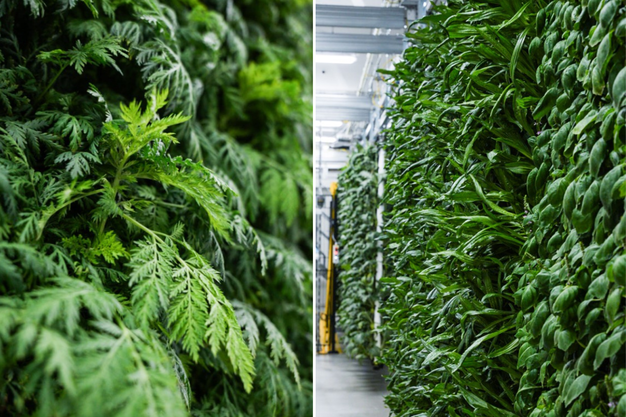 © Supernormal Greens - Ljusgarda
Precision elicitation at scale
The company has already transitioned more than ten medicinal plants from research into large-scale production, demonstrating, in Lundgren's words, that "CEA goes far beyond food."
At scale, it applies what it calls precision elicitation. In practical terms, this means deliberately activating plants' natural defense systems through controlled stress conditions in light, climate, and irrigation. The goal is to increase the concentration of high-value compounds relevant to pharmaceutical, cosmetic, and nutraceutical applications. "We are focusing on the true value of plants, which is their active compounds," Lundgren says. "Leveraging years of biological insight and technology development to create ingredients that have the potential to heal people and the planet."
The approach builds on Ljusgarda's earlier statements about precision control within its facility in Tibro, Sweden, where individual rooms allow independent management of light and irrigation parameters. In a previous discussion with Vertical Farm Daily, the company emphasized that such controlled stress treatments can be applied not only at R&D scale, but at ton-scale production volumes.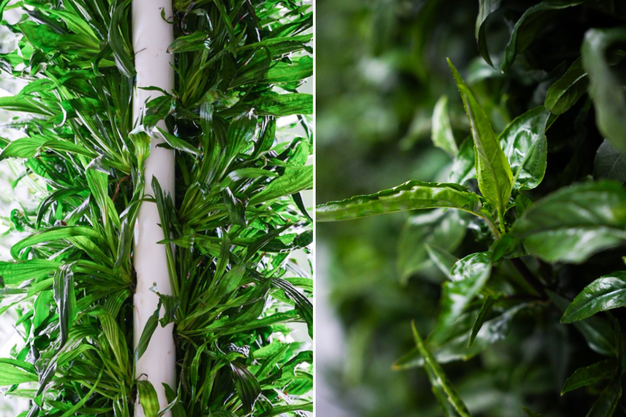 © Supernormal Greens - Ljusgarda
Changing the KPI
The pivot also signals a change in how performance is measured. In lettuce production, value is tied to fresh weight and short shelf life. In medicinal crops, value shifts toward compound concentration, consistency, and extract yield.
"For lettuce, it was all about growth, reaching maximum output in minimum time. The opposite of what we are doing now," Lundgren says. "Output and growth cycle are still important, but most important is quality, meaning potency of compounds and safety."
Lundgren frames this as moving away from "selling fresh weight" toward selling functional potency. The implication is that profitability is no longer constrained by pallet value or retail turnover, but by the concentration and reproducibility of specific bioactive compounds.
For more information: 
Ljusgarda AB
Erik Lundgren, Co-Founder
[email protected]
www.ljusgarda.se