The U.S. consumed about 99,000 tons of ginger rhizome last year. The crop, often incorrectly referred to as ginger "root", is widely used in food and beverage applications, including stir-fries, confectionery, curries, teas, and supplements. Global ginger production is concentrated in tropical and subtropical regions such as India, China, Indonesia, Nepal, Nigeria, Peru, Sri Lanka, and Bangladesh.
Domestic production remains limited. In 2024, the U.S. produced about 664 tons of ginger, accounting for roughly 0.7 per cent of national consumption, making ginger one of the crops with the highest dependence on imports.
 © Illinois Extension
Potential for Midwest production
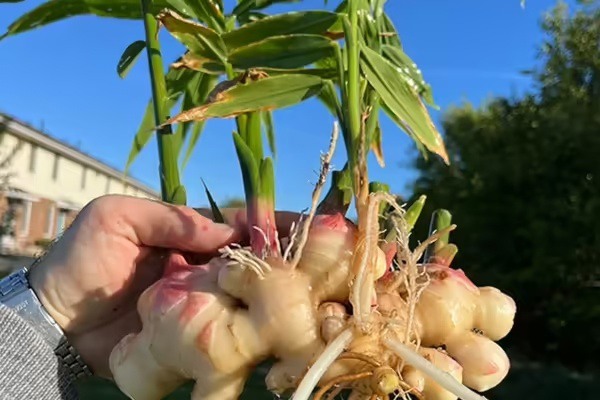
Research associated with the University of Illinois Extension suggests that fresh or "baby" ginger could be suitable for specialty crop production in Illinois and parts of the Midwest. Unlike mature ginger, which requires 8–10 months to reach full development, baby ginger can be harvested after around five months, aligning more closely with the regional growing season.
Baby ginger differs from mature ginger in several respects. It is less fibrous, has a shorter shelf life, and does not require peeling, characteristics that suit certain culinary applications such as sushi, ginger, and candied products. Harvest takes place late in the growing season, providing income when other specialty crop revenues are typically declining.
Research and field trials
In late 2024, a project led by Nick Frillman, Local Food Systems and Small Farms Extension Educator in Bloomington, received an Illinois Specialty Crop Block Grant to support fresh ginger research during the 2025 and 2026 growing seasons. The work builds on earlier Extension initiatives and focuses on production practices, including seed sourcing, transplanting, fertility and water management, pest control, and post-harvest handling.
Field trials began in spring 2025 with seven specialty growers and five Illinois Extension educators. Five ginger varieties from three suppliers are being evaluated across four production environments considered feasible for Illinois conditions. The aim is to assess yield performance and production reliability.
Early results from 2025 showed limited variation between varieties, while one production environment outperformed the others. Conclusions will be drawn after data from the 2026 season is collected.
Expanded trials in 2026
Participation will increase in the second year, with 14 specialty growers and six Extension staff beginning pre-sprouting activities in late March 2026. Observations from the trials suggest that production outcomes are influenced by irrigation frequency, fertility programs, and soil tillage practices. According to Frillman, "regular watering (every 1–2 days depending on soil type or potting media), regular fertility applications, and monthly hilling of soil around the base of plants, as is done for field potatoes," are among the key factors being monitored.
One participating grower, J. Balmer of Epiphany Farms Estate in Downs, Illinois, commented: "It's broadened our product offerings, introduced me to several like-minded growers, and provided the educational foundations to continue developing a high-value addition to our bottom line."
For more information:
Illinois Extension
Email: [email protected]
www.extension.illinois.edu