As the second half of the citrus season begins, the European Union's rapid alert system for food and feed (RASFF) has identified the first batches of Egyptian oranges containing residues above permitted limits, as well as phytosanitary materials banned for European citrus. The Valencian Association of Farmers (AVA-ASAJA) reports that Egyptian oranges were intercepted in Italy with 0.21 mg/kg of chlorpropham, a herbicide and growth regulator banned in the EU since 2019, reaching levels up to 21 times the allowed maximum residue limit (MRL).
AVA-ASAJA warns that Egypt's fruit and vegetable imports have multiple non-compliances, with seven notified by RASFF in 2026 alone. In 2025, Egypt had 131 interceptions, 83 for fruit and vegetables, 26 for citrus, and in 2024, a record 180 interceptions, 86 for fruit and vegetables, 34 for citrus. Over five years, Egypt recorded 672 detections.
 © AVA-ASAJA
Over the past five years, the active substances found in Egyptian fruit and vegetable products at European ports of entry, ranked by their restriction levels for EU producers, are: chlorfenapyr, phenthoate, profenofos, diazinon, dimethoate, chlorpyrifos, flumetralin, and chlorpropham.
Based on this data, Cristóbal Aguado, president of AVA-ASAJA, said that "Egypt is a country failing to meet food safety standards and endangering the health of European consumers." He called on commercial operators, importers, and large distribution chains to prioritize EU-grown citrus, which adheres to stricter standards than fruit from third countries. He emphasized the importance of supporting local produce to uphold corporate social responsibility and ensure freshness, food safety, and sustainability. He also encourages consumers to "buy locally produced citrus, as it guarantees maximum health and environmental protection, unlike citrus produced in Egypt and other non-EU countries. We can learn from the French and Italians, who buy locally first and import only when necessary. If we stop consuming our oranges, citrus farmers could vanish, taking an irreplaceable heritage with them."
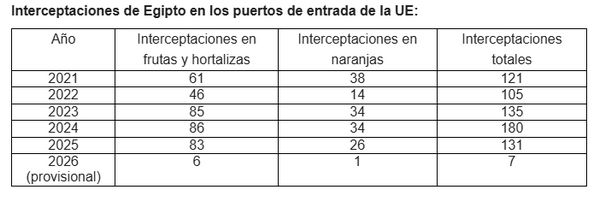 © AVA-ASAJA Source: AVA-ASAJA from the RASFF community portal
 For more information:
AVA-ASAJA
[email protected]
www.avaasaja.org