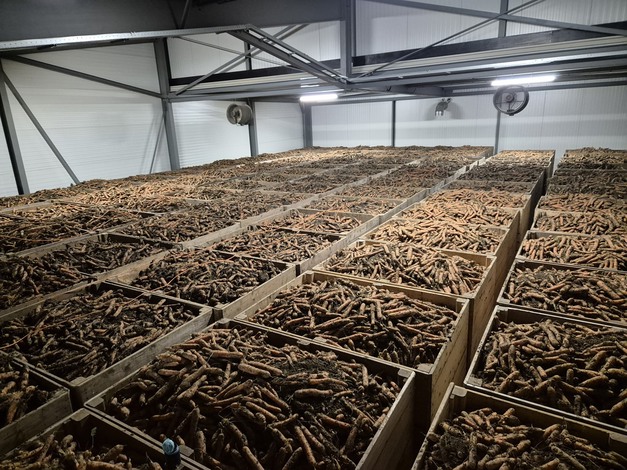
The month of January started very quietly in the carrot market. "We harvested until Christmas Eve, after which it started to freeze. Then a lot of carrots were put into sheds or stored under canopies, which were later sold as barn carrots alongside contract volumes from cold storage," says Caroline Louwerse, who, together with her sister Judith and father André, runs the carrot trading company in Emmeloord. The company focuses on trading early carrots and storage carrots, with sales both domestically and internationally.
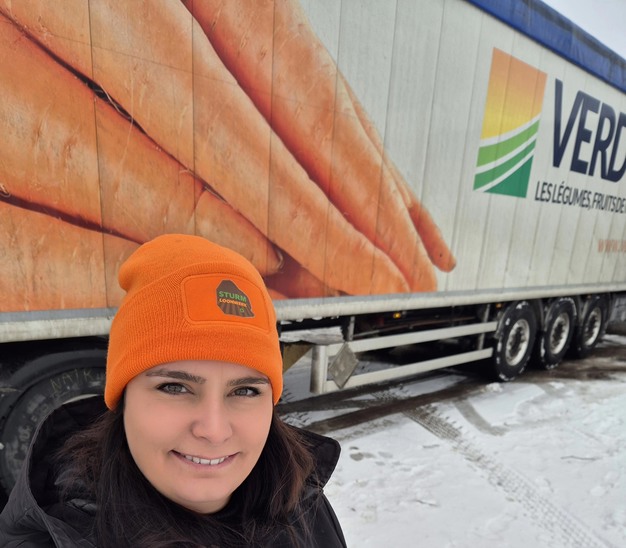 © Fa. André Louwerse WortelenCaroline Louwerse
 © Fa. André Louwerse Wortelen
"Initially, demand was limited, but in the second and third weeks of January, a lot of demand emerged from the Eastern Bloc, among others, although at low prices. The quality of Dutch stock from cold storage is variable. At the moment, ring rot (pictured right) is the biggest cause of lower quality, sometimes also in batches we did not expect," Caroline continues. "But you can see tension developing now. Customers want good carrots; they have seen enough inferior lots by now, but growers also want to be paid accordingly. The current exchange price of 11 to 15 cents is nowhere near sufficient. As a result, growers are holding back good lots for the time being. At the same time, there are also lots in storage that should urgently be processed, but which are not yet being offered or taken."
"Overall, cold-stored stocks in the Netherlands are large. The average box yield per hectare this harvest season in the Flevo and Noordoostpolder areas was up to 15 per cent higher than last year. The number of hectares planted with winter carrots declined slightly compared to last year. Despite this slight reduction in area, total production has still increased. In the five years I have been active in the carrot trade, I have never experienced such high box yields," Caroline continues.
 © Fa. André Louwerse Wortelen
The carrot trader also sees some positive signals. "Last year, the season also started quietly, and there was no major breakthrough throughout the season because neighbouring markets had sufficient stocks of their own. This year, I am more optimistic. From both Belgium and Germany, I hear mixed stories about cold-store quality, and I expect that sooner or later we will have to step in to supply those markets. Another positive factor is that in the Netherlands, we were able to harvest the vast majority of carrots before Christmas, and after two frost periods, harvesting directly from the land has now come to an end. In previous years, we often still had to compete with carrots freshly harvested in January," Caroline explains.
 © Fa. André Louwerse Wortelen
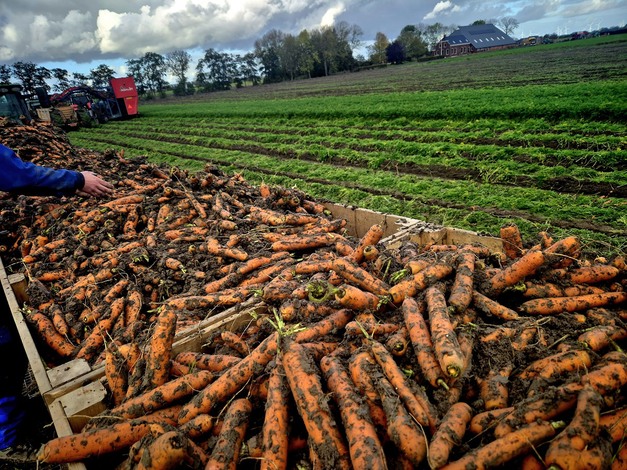
Harvest in late 2025 at a grower in Groningen
"Organic carrots are also not flowing into the conventional market at the moment because the organic market is developing positively. In other years, we sometimes see organic carrots ending up on the mainstream market. At present, however, the organic carrot market stands in sharp contrast to the conventional market. Slightly less acreage has been harvested in the Netherlands, and Germany required a larger share of Dutch organic carrots early this year. Since 80 per cent of Dutch organic carrots are shipped to Germany, that market is much more positive. Prices in the organic market reach up to 46 cents per kilo for good-quality carrots. We have harvested more coarse lots in the Netherlands due to favourable growing conditions. Very coarse lots are not always desired in the organic market. For conventional carrots, however, the season will be more challenging."
 © Fa. André Louwerse WortelenFor more information:
Caroline Louwerse
Fa. André Louwerse Wortelen
Espelerweg 8 II
8303 HX Emmeloord
[email protected]