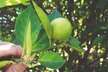
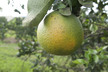
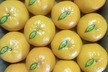
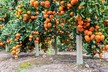
The protected clementine variety Sando, which first appeared in the Plana Baixa region of Castellón, Spain, as a result of a spontaneous mutation, is making headway in Italian citriculture thanks to its performance and the strategic commercial window it offers in the Italian market, where clementines are very popular among consumers.
"In Italy, the production window of the traditional Comune clementine is increasingly shorter due to the impact of climate change on its quality," says Joan Antoni Caballol, manager of Sando Clementine.
 © Sando Clementine
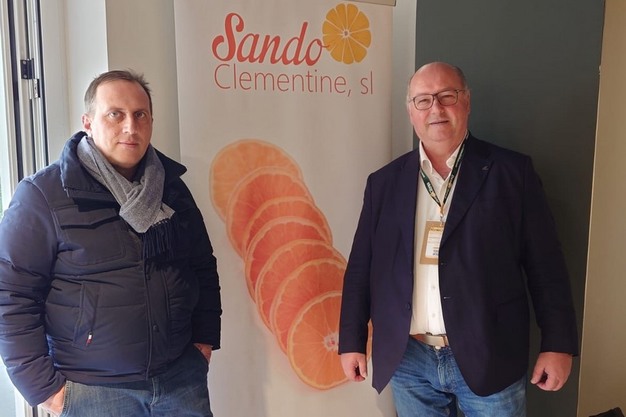
Pasquale de Simone, owner of Vivai Pasquale de Simone, with Joan Antoni Caballol, manager of Sando Clementine.
"In this context, the Italian citrus sector is looking for alternatives to extend the clementine campaign before continuing with mandarin varieties like the Tango. Sando makes it possible to achieve this, not only because of the productivity it offers but also because of its organoleptic qualities compared to other free varieties," he says.
Sando Clementine has recently reached an agreement with the Vivai Pasquale de Simone nursery for the exclusive rights over our Sando variety and the distribution of Sando plants and plant material in Italy. Sando is thus becoming the only variety protected by the European Plant Variety Office CPVO that's available in the second part of the citrus season.
"Since the first licenses were sold to the grower Giacovelli, and after several years of advice to allow the plant to adapt to the characteristics of Italy's soil, a quality production of around 180,000 kilos has been obtained this year, with hopes to reach approximately 250,000 kilos in the next," says Joan.
"Now, through Vivai de Simone, the variety aims to become part of the portfolio of the five largest fruit and vegetable groups in the country. For example, Gruppo Manzoni will have 11 hectares planted with Sando this year," he says.
According to Joan, although its flavor is very similar to that of the Spanish Sando, the Italian Sando arrives a little later, so there won't be an overlap in sales. "Sando aims to carve out a significant niche in the domestic market, which consumes a lot of clementines, and it could also have greater access to parts of Switzerland, Germany, and Eastern countries that Spain isn't able to cover," says Joan A. Caballol.
For the time being, Sando's acreage in Italy will be limited to 300 hectares. "We are going to do our best to facilitate the planting of the first 100 hectares," says the Sando representative.
 © Vivai de SimoneFor more information:
Vivai De Simone
Tursi (MT) - Italy
Tel.: +39 351 1590461
Cell: +39 320 2198813
[email protected]
www.vivaipascualedesimone.com  © Sando ClementineJoan Antoni Caballol i Angelats
Sando Clementine, S.L.
Av. Generalitat, 104, 1.º C
43500 Tortosa, Spain
Tel.: +34 609045598
[email protected]
www.sandoclementine.com