 © Contour LogisticsFresh cargo specialist Contour Logistics long ago made the decision to be an agile service provider for exporters needing sea freight. They made the decision not to invest in cold storage depots or other assets. "Our biggest advantage is that we're small and we're agile," says managing director Mariaan Rademan (right). "We work in the best interests of our customers, not in the best interests of our assets."
Concentration among shipping lines over the years means their shipping options are few: on sailings to Europe from Cape Town, including breakbulk vessels in season, they have a choice of three to four weekly vessels. It has been an unpredictable season, she says: fruit has been ripening earlier in the orchards and vineyards than indicated in the initial seasonal forecasts to shipping lines.
Shipping lines lost their personal touch
"The personalized service between the exporter and the shipping line is disappearing," Rademan observes. "In those organizations, the older individuals are still very relational in their approach to clients, the way it used to be 20 years ago, when it was like having a personal banker. That has been a substantial change I have observed over the years in the industry."
She does not expect their freight forwarding role ever be subsumed by the shipping lines. "In our industry, where things are fast-moving and extremely detail-oriented, I do not see that shipping lines will succeed. Shipping lines deal with far too many customers and high volumes, so it is just not possible for them to give the level of detail that perishable cargo requires. I have never seen any container of fruit moving out of South Africa on a standard operating procedure. It is just not possible."
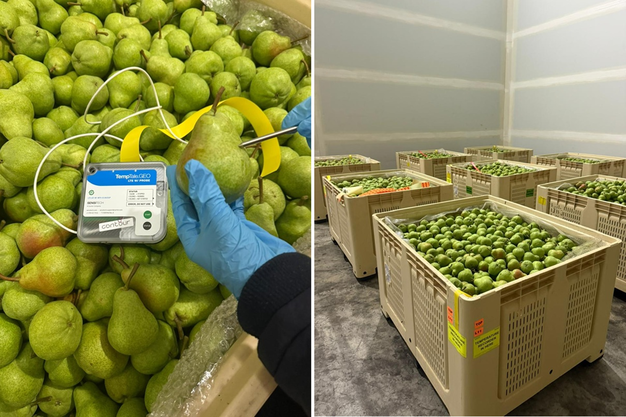
From the moment a container stuffed with fresh cargo has been loaded at the cold store, a client needs to know where the shipment is in the process, along with continual temperature readings, the time of discharge, and gate-in and out details. This is possible, irrespective of the choice of shipping lines, whereas a shipping line does not offer this.
"Getting fruit out is the easy part - it's when you're trying to be cost-effective and do it economically for your customer that you're stuck," she remarks. "Everything we are doing to get the fruit out now costs the grower thousands of rands: we are trucking to Port Elizabeth to avoid the bottlenecks here [in Cape Town], and then we create a bottleneck in PE. We even trucked from South Africa to Namibia – the industry is shipping more volume through Walvis Bay this season."
She continues: "The Namibian port, although very efficiently run, remains an expensive option. Even if production is based in Aussenkehr [Namibia], your transport to Walvis Bay is 50% more expensive than to Cape Town."
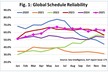
One of the knock-on effects caused by Cape Town's omission to maintain schedule integrity because of wind and other delays has been the availability of reefer containers. "When vessels carrying empties bypass our ports, we run into a reefer availability problem, like during the last two weeks. It's very challenging."
She expects reefer container constraints to be a recurring feature as South Africa's export volumes grow further, and while port efficiencies remain "questionable".
 © Contour Logistics
More use of breakbulk over past 2 years
The fruit industry has grown so much that once one bottleneck is resolved, the next bottleneck pops up, she observes. During the grape and deciduous season, breakbulk vessels call at Cape Town and load at a private, less wind-affected terminal at the port of Cape Town. Why are more exporters not using that? "Because most grower packhouses pack hicube pallets for containerized cargo and struggle to make the switch to standard height pallets in the packhouse," she explains. Hicube pallets do not fit into the holds of the specialized reefer vessels calling South Africa, but if these vessels could replace the standard pallet holds with hicube holds, there would be more support for specialized reefer vessels from the industry's side.
The other challenge with breakbulk, Rademan continues, is that their shipping routes employ smaller vessels, pushing up the cost per unit. That said, during the past two years, the industry has made more use of specialized reefers, she says. "Finding the volumes of grapes to fill up a breakbulk vessel for Dover and Rotterdam has become much easier than three or four years ago. The effect of delays on fruit quality is more expensive than the differential in shipping costs. During the citrus season, break bulk programmes to Europe and Philadelphia in the USA have become a complementary, reliable and standardized option from South Africa."
The transit time with breakbulk is on average three days faster, calling at fewer ports than container vessels, even though steaming at a slower speed than container ships.
Saldanha Bay would've been perfect
"The next logistical constraint we expect," she remarks, "would be for empty depots to be able to supply containers fast enough in a short enough period (stack days) to fill the larger containerized vessels calling South Africa."
The dream Rademan says she's cherished for 25 years – an unrequited dream, probably, she acknowledges – would be a port not in the heart of the city, and not right in the wind funnel created by Table Mountain: a port somewhere like Saldanha Bay, a natural deepwater harbour without city traffic.
 © Contour Logistics
The Contour Logistics team
 For more information:
Mariaan Rademan
Contour Logistics
Tel: +27 21 918 4900
Email: [email protected]
https://www.contourlogistics.co.za/