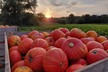
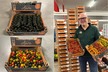
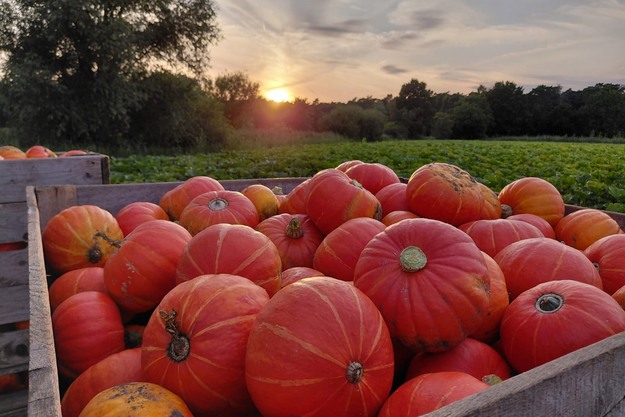
The pumpkin season is currently struggling. Prices on the free market are almost impossible to achieve, and there is no outlet for smaller sizes. "Thanks to strong partnerships with Belgian supermarkets, we have been able to sell our volumes well, but for the smaller sizes, we had to launch a campaign with Waste Warriors," says Jeroen De Ridder of Jeroen Pompoen.
 © Jeroen Pompoen
"Looking at our sales overall, we personally cannot really complain," continues the grower from Sint-Gillis-Waas, who is a member of Coöperatie Hoogstraten. "Some supermarkets even asked whether they could continue longer, and we agreed. In stores, promotional actions will run until the end of January, as long as the quality remains good. Outside these agreements, however, the situation remains very difficult. We hear this everywhere. For example, I understand that some players in the Netherlands are only just starting deliveries. Germany is still completely saturated, which is a major market for Dutch pumpkin exporters, so demand is minimal."
"And then you also have to take into account that from week 6 or 7, the first Moroccan product enters the market, after which Morocco is in full production by week 18. This means the sales window continues to shrink." Is there still value in extending the season through better storage? "This is being researched, but I find it tricky. Essentially, you need to make sure everything is sold by mid-February, unless you make agreements with retailers to extend the season. In that case, they may still support local product if the price is right, but from March onwards, pumpkins barely move, as many new vegetable varieties become available again."
Portuguese supply to South Africa
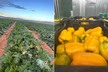
So it is a difficult situation for Hokkaido pumpkins, but at the same time, there are plenty of sales opportunities for Butternut pumpkins. "Smaller sizes are also selling well there, and that is still continuing," he says. "In addition to the final Belgian Butternuts, we also have a Portuguese supply that we can use once the Belgian season ends. We began importing Portuguese product last year to extend our Butternut season slightly after the Belgian season, and that worked so well that we restarted Portuguese Butternut again last week."

"We are now almost completely through our own Butternut stock, but from customers, I understand that Belgian stocks will be available until around week 6. Our Portuguese supply then serves as a good bridge until about week 10, and possibly a bit longer. Last year, the final Belgian stocks were already exhausted by the end of December, but this year they are lasting much longer. This leaves more volume and potentially allows us to continue for longer."
Customers are comfortable with this transition, Jeroen assures. "Portuguese pumpkins are comparable in quality to Belgian ones. In the past, people even claimed they were of better quality, but I think that is beside the point. The real difference is storability, which is better. Why that is the case, I suspect, may be linked to harvest conditions. We see in Belgium as well that harvest conditions greatly affect storability. Moreover, customers find it convenient to continue with Portuguese supply for a while longer, because otherwise they would have to purchase full containers from South Africa, which they say are difficult to sell through in time. This way, they can continue working with smaller volumes."
Smaller pumpkins
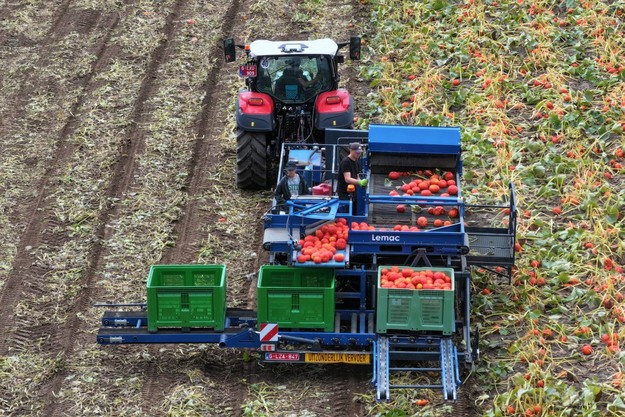
In the end, Jeroen did manage to find an outlet for most of his volumes, except for the smaller sizes of Hokkaido. "In terms of volume, these sizes account for a relatively limited share. From a total yield of 1,200 tons, only 20 tons are smaller than 800 grams, which is not a large quantity. However, supermarkets require a minimum weight of 800 grams, so we are very keen to find a place within the food chain for these pumpkins. Through joint initiatives with Waste Warriors and No Waste Army, we have now found buyers who will take the pumpkins to France, which is a positive development."
 © Jeroen Pompoen
Meanwhile, it became clear on Wednesday that the campaign attracted large numbers of local residents to the farm, who together purchased thousands of kilos of pumpkins. The pumpkins were sold in five-kilo packs and proved appealing to consumers. Thanks to this initiative, around six tons were sold directly. The remaining ten tons were donated to food banks, ensuring nothing went to waste. This is a relief, but at the same time, Jeroen emphasises that this is only a temporary solution and calls for a change in mentality among supermarkets, for example, by promoting smaller pumpkins or incorporating them into freshness packs. "This approach is already common in other countries, but in Belgium, it sometimes still lags behind too much."
For more information:
Jeroen De Ridder
Jeroen Pompoen  Heerweg 3
9170 Sint-Pauwels, Belgium
Tel: +32 (0) 484 73 86 64
[email protected]
www.jeroenpompoen.be