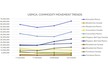
The global demand for avocados continues to increase, making this tropical fruit's market more attractive. In fact, avocados are expected to become the world's second most traded product in their category by the end of this decade, remaining only behind bananas. The data provided by FAOSTAT reveal that between 2010 and 2020, the global area devoted to avocado cultivation has increased from 432,000 hectares to more than 800,000 hectares, and the production now exceeds 8 million tons after increasing by 113%, from the 3.78 million tons recorded 12 years ago.
In just a few years, the number of origins, producers, exporters or retailers working with avocados has multiplied globally. In order to connect all players in the value chain and create a communication platform that can also boost the trust in the fruit, AvoPrice has increased the functionality of its application by extending it worldwide, thereby knocking down the barriers of distance or language. It is giving distributors in any destination market a place to showcase their products and advertise their companies.
"Our goal is to create an efficient and transparent avocado chain that generates value for every link, from the producer and exporter to the distributor or retailer," says José Humberto Solórzano, creator of AvoPrice. "Through digitalization and information it is possible to empower the distribution chain so that the fruit can arrive from any point on the planet to its destination while generating a profit for everyone involved."
"Avocados are a highly valued fruit, with consumer prices that remain generally stable throughout the year, but they are also subject to the problems of all other products in the world; that is, the inefficiency of the chains. This not only means that producers do not get a fair return for their work, but that the same inefficiency is passed on to consumers."
"That is why now the avocado supply chain, led by Mexico, is ready to go digital and expand to the entire planet."
Demand with high global growth potential
Avocados and their most famous processed product, guacamole, have become standard products in supermarkets and retailers in the Americas and Europe, regions where per capita consumption is expected to continue to grow, especially in Europe, where the average consumption of avocados is still about one-third that of the United States. There are other regions with enormous potential, such as Asia, with China leading the way, or the Middle East.
"With AvoPrice, we want to connect producers with exporters in the same system, bringing together Peruvian, Kenyan, Israeli or Colombian exporters with fruit distributors in destination markets around the world, so that there is equality of circumstances and opportunities both at origin and destination, as well as transparent access to information. For example, in China, a country with more than 1.4 billion people, there will be thousands of companies that want to import the product, but need an intermediary they can rely on to do so. And that intermediary can be AvoPrice," says José Humberto Solórzano.
"In order to offer trust, transparency and fairness along the value chain and guarantee end-customer satisfaction, we are connecting independent companies that certify the condition of their products upon departure and arrival at destination, and we are looking for financial companies to connect, help us and provide financing to qualifying buyers."
In a sector as dynamic as the avocado industry, having the most information and supply options is an advantage. "The market is constantly changing. For example, the export of avocados from Jalisco to the United States has just opened. Until now, it had been shipping its fruit to Europe and the Middle East, but next season they are likely to start sending their avocados to the North American market, and fruit from other origins, such as Peru, may need to find new destinations. Another example is what happened recently in Michoacán, which is currently affected by the temporary suspension of exports due to an isolated event that has unfairly harmed thousands of growers working legally to offer the best fruit to U.S. consumers."
"If this decision is extended, it will have an impact not only among producers and the Mexican industry, but also on U.S. consumers," says José Humberto. "If the problem is insecurity in our sector, which is our source of food supply, they should fight for our security and not take away our livelihood."
Empowering the avocado value chain is empowering the producers.
AvoPrice was born 3 years ago, following the third strike organized in Mexico due to the low prices that producers were receiving for their fruit. "We have a very valuable product, appreciated around the world, and with an industry with significant growth prospects. By connecting producers with exporters and exporters with distributors, and by digitally organizing the distribution, we not only achieve a more efficient chain and consumers have a better product; we also help producers obtain fair returns."
"We producers don't like migrating; we do it because we don't know what to produce or where to sell our products, and sometimes we don't know if we're going to get paid. In the end, everything boils down to the problem of finding a place for the information from the distribution chains. The avocado chain can solve every other problem, and that is my struggle."
 For more information:
AvoPrice
Tel.: +1 4257657491
www.avoprice.com