It’s a tough season, tough as nails, says Hannes de Waal, managing director of the Sundays River Valley Citrus Company (SRCC) based in Kirkwood, Eastern Cape, but it is redeemed by a single factor: the weakening exchange rate, almost R17 to the euro and R15.22 to the US Dollar.
“It’s a very complicated, very difficult season, but the reality is disguised by the exchange rate. It is the saving grace of the citrus industry this season. The rate to the Dollar is really a great help to us,” he says. (During January the Rand strengthened to below R13.50 to the Dollar, which contributed to the difficulties of the past South African table grape season.)
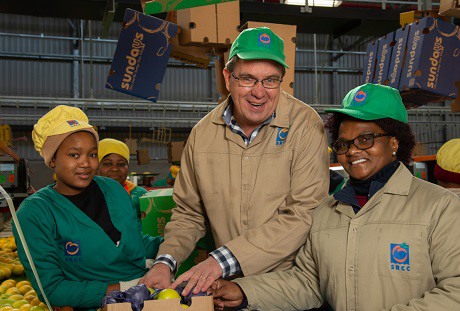 Hannes de Waal, MD of the SRCC in centre, with Nokwanele Mzamo, general manager of Luthando Farm, on the right, among Kirkwood packhouse workers
“Valencia prices some of the best I’ve ever seen”
Valencias are the highlight, especially for Valencia producers in the Western and Eastern Cape. Around Letsitele, drought has caused a drop in volumes (estimated at around 20% by northern growers).
At the SRCC they had an average fruit set with average size distribution (72, 64, 88), plus some smaller 105s and 125s, and the European and Middle Eastern markets are paying very good prices for smaller Valencias at the moment.
“It's some of the highest prices I’ve ever seen for Valencias, and it’s just down to plain old supply and demand, driven by the growth of the in-store juicing category, hence the requirement for smaller fruit,” Hannes explains. “Europe and the Middle East are competing head-to-head for juicing orange supply.”
Lemon prices dip 20 – 30% YOY Hannes is very wary of the prospects for late entrants to the lemon category, particularly those coming from other sectors like, as in the Western Cape, wine farmers taking out vineyards for replacement with lemons.
“World production has grown tremendously. This is our game, and we knew it was coming, but there are some hard realities out there, and one of them is: if you’re not already in the citrus industry, you have to be thinking very carefully before you plant lemons. That window has closed."
"Year-on-year lemon prices are 20% to 30% lower," he continues. "In Europe we see prices 15 to 30% lower; in the Middle East the bottom lemon prices are 20 to 25% lower than they were last year.”
The size distribution on lemons was very good, except for a decrease on their third set which is a bit concerning.
“It’s been a dry spring. If we don’t get 5 or 10mm during October, we’ll feel the effect next season.”
On mandarins, prices drop 5 to 10% year-on-year as the forecast growth in volumes starts manifesting itself. “It’s a different mandarin game to before, the market is changing and the growth in soft citrus is very clear.”
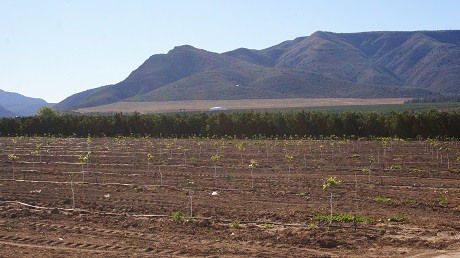 Young orchards in the Sundays River Valley
Very late switch to Southern Hemisphere shortens window
The early navel season was a difficult period. “The wholesale market in Europe isn’t an easy market anymore. The average for Egyptian Valencias is about the same as domestic prices in South Africa, because their transport costs are so low. It wasn’t a bad season, but until about week 24 it genuinely wasn’t a good one.”
As usual, late navels lifted the market outlook, and prices were fair, but the trend of dampened navel prices was accentuated this year by Spain’s large harvest, Hannes says.
European retailers switched over to Southern Hemisphere stock much later than usual, as markets remained full with Spain’s particularly long season and Egypt’s fruit, on Europe’s doorstep, resulting in a very short window.
“Usually by week 24 you’re sorted out, with some guys already taking South African fruit starting in week 20, but this year we only got going by week 29. I estimate the switch-over to Southern Hemisphere supply came as much as 10 to 12 weeks later than usual.”
Wind damage wipes out volumes gain
Packouts have been “terrible” because of the wind, Hannes says, and he notes that it’s inevitable that more and more orchards will have to go under nets, particularly in places like Barkly Bridge.
He recounts that some growers harvested 10 to 20% more on an orchard, only to see the same export volumes as other years, as wind damage and poor packouts wipe out volume gains.
“Fruit management is risk management, but when you are confronted with some of the external risks with which we’ve had to contend this season – the situation at the harbours, or protesters blocking roads with rocks during service delivery protests – it makes it all the more difficult.”
Government not sufficiently sensitive to industry's external risks
“We’re in a very competitive world. South African fruit isn’t alone on the market, clients don’t have to buy our fruit. The government is not sufficiently sensitive to the disruptions caused to the industry by unregulated labour action or protests that block roads. It is going to have to extend protection to industries like the citrus industry, because companies go under in an unfavourable environment.”
“We’re very sympathetic to the socio-economic realities of South Africa,” he continues, “and we invest a lot in projects and employment creation, but we need government in our corner.”
At the SRCC they’re not sending large volumes to Cape Town or Durban anymore. The situation at Port Elizabeth and Coega harbours have definitely improved, but the repercussions are still felt in an intermittent container shortage, disrupted shipping schedules and irritated clients.
For more information: Hannes de Waal
Sundays River Citrus Company
Tel: +27 42 233 0320
Email: [email protected]
https://www.srcc.co.za/