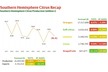
In the market report of September 19, 2018, Capespan's Mark Greenberg highlights that the "easy peelers market hit rock bottom in the previous week and is slowly recovering to more normal levels in September," adding that the modest market growth has a lot to do with the good demand at the end of the summer, combined with the fact that the shipments of late mandarins from Chile have been reduced by more than 20% up until week 36. Meanwhile, the late mandarins from Peru (W. Murcott and Tango) are widely available, with 150,000-200,000 boxes arriving weekly to the East Coast of the United States (USEC).
Today, according to the professional, 10 x 3 lbs bags of standard size easy peelers reach prices of between US$ 28 and US$ 32 (mostly US$ 30) in the USEC market. The current goal is to reach US$ 32-34. Small sizes (5s) are sold for between US$ 24 and US$ 26 in 10 x 3 lbs bags.
Chilean mandarin shipments will continue to grow, although there is likely to be a gap due to the Fiestas Patrias period in Chile. The packaging will resume again in week 39, so there shouldn't be an impact on the fruit's overall availability.
From a conservative point of view, by week 36, Chile still has to load another 40,000 tons of mandarins before the end of the season, most of which will go to the US (both coasts).
Greenberg highlights that local easy peelers are expected to become available in early November, and Mediterranean clementines will start arriving in the USEC soon after. "The result is that there are only eight or nine weeks left for the marketing of easy peelers in the southern hemisphere. In this period, both the 29,000 tons loaded since week 34, which have not yet arrived, and the 38,000 tons still to be shipped to the US, have to be marketed. Traders will have to work hard and generate promotional opportunities to sell this fruit at affordable prices."
Navel oranges
Greenberg points out that up until week 36, 51,883 tons of Navel oranges have been shipped by Chile to the USEC, which entails an increase of almost 26% compared to the same period of the previous season. Furthermore, another 29,770 metric tons have been loaded to the USWC (West Coast of the United States), with an increase of more than 25% compared to the same date of the previous season.
Meanwhile, South Africa's shipments consist of 32,150 pallets of Navel oranges (with 30,500 pallets having arrived to the USEC), and 675 of Midknight, which will arrive in week 38. More volumes are expected to arrive during the month of October.
While the shipment of Navel oranges continues gaining momentum in late summer, the stocks are plentiful, keeping market prices low. The great availability is not only the result of the huge volumes arriving from Chile and South Africa, but also of the large volume of easy peelers available throughout the summer, which has caused the sale of others citrus fruits to fall.
Today, prices for the Navel 64s oscillate between US$ 14 and US$ 18, with a demand for 48s that has eventually made it possible to raise prices. However, the demand for 40s is lower. The price of small fruit remains stable, with 72s and 88s selling for between US$ 16 and US$ 18. This will soon give sellers the first opportunity in weeks to carry out bulk sales at US$ 20. Navels packed in 9 x 3 lbs formats are sold for a wide range of prices, oscillating between US$ 17 and 22.
While Navel orange sales are really good, it will still take a few more weeks before the available stocks make it possible for the prices of large sizes to increase.
California shippers say they will start packing Navels in late October, but many retailers will wait until the beginning of November to make the switch. The early California fruit will have a small size and will probably remain in the west. It is unlikely that imported Navel traders will become complacent. This has been a challenging season, and will require tenacious and tireless sales efforts over the next nine weeks.