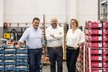
Managing Director Eliane Steinmeyer during the day in the empty wholesale market hall, where order pick-ups take place at night.
The heart of the wholesale market area was built in the fifties and sixties. That is why the central hall, where the pick-ups are done at night, is currently a protected monument. Unlike the majority of the 15 transhipment halls, the center of the site is not equipped with ramps. Nevertheless, the hall is still fit for use, according to Eliane Steinmeyer, Managing Director of the wholesale market. “There are no parts that could not be used for structural reasons. Restructuring measures have been taking place for some years now, taking place during the day, so that the night-time trading business does not have to be interrupted.”
Many requests for leases
Unlike many other hypermarkets in Germany, all outlets in the Hamburger Markthalle are currently leased. And there are still requests, confirms Steinmeyer. Also, in the basement of the central hall, almost all storage rooms are already taken. Among other things, this has to do with the fees: the rental prices have been at a moderate level for some years, and the marketers have many advantages. Particularly the infrastructure, with a proximity to the port and a location next to both the motorway as well as the city center, is a great incentive for new traders. Next autumn, an electric charging station for delivery vehicles is will come into use.
As a result, the Hamburg wholesale market continues to establish itself as the central trading hub of northern Germany, where regional restaurants and large-scale consumers as well as buyers from, among other Poland and Denmark, come round at night. However, the large-volume trading activities do not take place in the central hall but in the 15 transit halls around it. Steinmeyer: "The resident trading companies are also largely involved in supplying the major retail chains. This results in different handling volumes for the individual companies and requires a corresponding area of several thousands of square meters.”
Different events
During the day and on weekends -when there is no wholesale trade taking place- everything is being done to optimally utilize the space. A few years ago, the "Mehr! Theater am Großmarkt” started taking place. Currently this comprises of about 4,000 square meters on the ground floor and another 1,000 square meters in the basement of the central hall. In addition, great events are also held regularly in the weekends on the wholesale market area, so that the parking lots and the area as a whole are in use also outside of the commercial activities, fulfilling a useful function.
Together with the Hamburg Wholesale Management Cooperative, in which over 90 percent of the trading companies work together, the administration has set itself the goal of making the wholesale market better known in the region. In this context, there is an annual food market in Hamburg. Not only fruit and vegetables are offered to consumers, but flowers, delicacies, spirits, high-quality gastronomy, and much more as well. Steinmeyer: “We also provide guided tours at night, when people are at work here. There is very much enthusiasm for these tours. The press has come down as well, fuelling people’s interest even further. We are now fully booked until November.”
Current developments and future
Despite the outstanding enthusiasm for the wholesale business and its versatile offerings, however, the Hamburg trading companies inevitably have to contend with the current challenges. Certainly the smaller, owner-managed companies often have problems to secure their succession, because the new generation often takes other paths, the irregular hours being one of the main reasons. These companies are eventually taken over by colleagues. Steinmeyer: "Of course there are trading companies that are familiar with certain specialties and serve a corresponding target group. In my opinion, however, the products offered and the customers tend to mix well. There’s a reason that there are many long-established companies here, already for the fourth or fifth generation."
Another tendency that is not necessarily positive for the wholesale market, is the declining pick-up business. After all, catering companies are increasingly being supplied by their wholesale partners. However, as the other trading centers of Northern Germany (Hanover and Bremen) are quite far away and there are no large producer markets that operate independently of the wholesale market, the Hamburg trading companies have a relatively large clientele.
Also, the rapid increase of online business is a development that is closely followed by people on the wholesale market. "Of course, because of its shelf life and perishability this is a bit more difficult with fresh produce than with clothing, books, etc. Furthermore, spontaneous decisions are very important, especially with fruits and vegetables: Amazon experiments with online shops, but we have to wait and see how this develops over the years."
In any case, the management looks positively into the future. "Of course there are challenges, but I do not see anything ahead that could possibly be the end of the wholesale market. We are still accepted by the buyers, the demand for space is there. The business models are changing, but the wholesale market area with its transshipment function is still establishing itself as a major trading hub, Steinmeyer concludes.
The Hamburg market area in numbers:
- Total area: 27.3 ha
- Transhipment facilities: 55.167 m2
- of which rented out to market companies: 26.807 m2
- owned by private companies: 28.360 m2
- Loading and unloading space for buyers: 88.538 m2
- Company parking spaces: 17,459 m2
Fruit and vegetable hall:
- Length: 220 m, width: 183 m, maximum height: 21 m
- Ground floor: 40,000 m2
- Mezzanine: 17,000 m2
- Basement: 40,000 m2
- Office space: 2,500 m2
For more information: