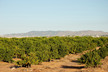
The Palacio de Portocarrero, where some Franciscans brought orange seeds from Palma del Río, Córdoba, on the second voyage of Christopher Columbus in order to plant them and prevent vitamin C deficits, has the key to the origin of California oranges.
Thanks to its location, between the confluence of the rivers Genil and Guadalquivir, as well as to its climate, Palma del Rio has traditionally been an ideal place for the cultivation of this citrus fruit, and some of its centenarian orange trees still live in the wonderful garden of the Palacio de Portocarrero, a place where "nature, art, history and gastronomy come together" thanks to the work carried out by the wife of the current owner, the Sevillian painter Cristina Ybarra, who has been involved for 25 years in what she considers "a life-long project."
As an artist and expert in the history of the town, she explains that one of the owners of the palace, Luis Fernandez de Portocarrero, first Earl of Palma, who served the Catholic Monarchs, founded a Franciscan convent in the town in the sixteenth century, from where some monks departed on the second voyage of Columbus in order to plant orange seeds from Palma del Río along the Camino Real of California.
"The monks, who departed to find their convents, planted these citrus to prevent scurvy," a disease caused by vitamin C deficiency characterised by sores in the gums and bleeding, explains Ybarra on a walk through the garden, whose artistic design she directed.
Because of this, she is developing, within the Palacio de Portocarrero, the project for the future orange museum, because although Valencia produces more oranges, the one from Palma del Río is the key to the origin of California oranges," and there is also a native variety known as "Cadenera", which makes the fruit in the area very unique.
This enclave has kept the centenarian orange trees that were planted in the Palma del Rio's oldest orchards. In today's garden, which aims to be a botanical one, there are currently more than one hundred citrus species and new ones are brought in weekly by companies and individuals; "a gem for agro-food researchers."
There are Eurosemillas varieties such as the Tango; older ones, such as the Citrus australasica, which is shaped like a small melon; the calamondina, from China; the kumquat, the native Cadenera, the sagustiana, the morumbi mandarin, rosette limes, Sanguinelli and even a bergamot brought from Calabria, Italy.
Moreover, the entire property has been declared a Site of Cultural Interest (BIC). It is the only historic palace in the Vega del Guadalquivir and its value lies both in its architecture, restored according to historical documents, and to the historical events that took place in it, such as the wedding of Gonzalo Fernández de Córdoba, "the Great Captain", with María Manrique de Lara.
It is therefore not surprising that, in February 2004, director Ridley Scott used the palace to shoot the film "The Kingdom of Heaven", as it evoked Orientalist scenarios that evoked the Holy Land.
Cristina Ibarra insists that "oranges are health, disease prevention, history, popular uses, healthy habits..." in short, they are part of the cultural and natural heritage of this municipality. For its part, the Palace of Portocarrero, which can be visited by making a reservation on its website, is an ideal place for celebrations with some flavour and, above all, with a smell that makes it a dreamlike citric oasis.
Source: EFEAGRO